"I can't be a pessimist, because I'm alive. To be a pessimist means that you have agreed that human life is an academic matter." -- James Baldwin

Friday, March 25, 2022

Are We Obsolete?

      I learned how to drive in our old VW bug. The car had no radio, hand-crank windows, and a four-speed manual transmission. I was pretty proud of my skills with a manual transmission, because not everyone could do it.

     But now, if you mention a manual transmission, people don't even know what you're talking about. If you want a manual transmission in your new car you have to special order it . . . and wait a few months for someone in China to build it.

     Definitely, driving a manual transmission car, being able to stop and start on a steep hill -- that's an obsolete skill.

     What else is obsolete?

     Fixing a car. You don't fix a car anymore. You just replace a computer chip.

     Reading a map. Everyone uses GPS now. My kids have no idea where they are, much less how they got there. They just follow instructions from their iPhone.

     Tuning into a radio station. I used to be able to rotate the dial and find Cousin Brucie on WABC 770 in New York, without looking at the display -- and when I was in the car, without taking my eyes off the road. Later on as a young adult I could find 1010 WINS, "all news, all the time." Now I just ask google to get whatever I want. I don't even have to touch the device. My sixth sense on the radio dial is completely obsolete.

     Writing. Remember in fourth grade -- or sometime around then -- learning how to write in script? Those flowing "a"s and bulbous "b"s? And how the "h" went above the line, and the "g" below the line? Nobody picks up a pen or pencil anymore.

     Typing. I took a typing class in summer school, the summer after 11th  grade. I tested at 50 wpm, and later managed 60 wpm when I got a Smith Corona electric my sophomore year in college. I was pretty proud of that, since all my friends either had to beg a girl to type their paper for them, or else they employed the hunt-and-peck method at around 20 wpm. But nobody types anymore. They thumb their text messages. That, however, turns out to be a skill beyond me. I resort to hunt-and-peck on the phone.

     Sewing. I recently found out that my wife owns a sewing machine -- and has for most of her adult life. I've known her for 20 years. But I've never seen this machine, much less ever witnessed her actually sewing. Is that because I'm an insensitive, inattentive male? No! It's because she hasn't used her sewing machine even once in all these 20 years. 

     Balancing a checkbook. What's a checkbook? Plastic is the way we pay these days, and even that's starting to get phased out, as the humble check was years ago. Soon we'll all just hold up our phone to a sensor. As for cash? That's for drug dealers only. And coins? People won't even pick them up off the ground.

     Telephone voice. It used to matter how you answered the phone, especially in business. You want to welcome your customers . . . and your friends. But nobody telephones anymore because nobody answers the phone anymore . . . because the only calls we get are robocalls. Instead we text, email, zoom, tweet or Instagram.

     Filing. There used to be a job title called "File clerk." No more. Files are gone. Paper is gone. Sorting by alphabet is a lost art. Now everything just gets sent to the cloud -- and the computers do the sorting.

     Tying a Windsor knot. Sporting a Windsor knot in your tie used to be a mark of class. Everyone knew you were destined for the executive suite. Now the black t-shirt is the dress code of executives. And a Windsor knot is nothing but a sign of pomposity. I don't know what the female equivalent of the Windsor knot is . . . maybe wearing a skirt and high-heels?

     I remember my first resume. I listed Xeroxing under my skill set. Well, that was pretty lame, even then. But if you know how to mimeograph, if you know how to Fax, don't tell anyone. If you use a paper calendar, hide it under your desk. And if you still have an aol email account . . . well, I guess that's okay if you're driving around with a manual transmission.

Saturday, March 12, 2022

Why Didn't We Retire to Florida?

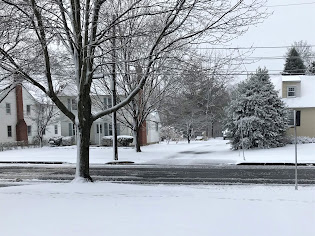
     I woke up this morning and it was raining. The temperature was in the high 30s. But by 9:30 a.m. the temperature had dropped into the 20s and the rain had turned to snow. 

     Three days ago it was 70 degrees in Pennsylvania! What's going on?

Pennsylvania today
     What's going on is the change of seasons. As my wife says: Think of March as winter, not spring. Then you'll be pleasantly surprised when it's nice out, and not disappointed when it snows.

     Then she reminded me, "Your friend Bill is on Sanibel Island this week."

     "Bully for him," I grumbled.

     "And don't forget to call your sister," she said.

     My sister lives in Jacksonville, FL. She's planning a trip to New York City later in April. We're trying to make arrangements to get together.

     Meanwhile, The Players golf tournament is going on in Jacksonville this weekend. I'll catch some of it on TV, and bask vicariously in the green grass, gentle breezes and friendly palm trees of Ponte Vedra. And I'll wonder: why again didn't we retire in Florida?

     Let me count the ways.

     It's too hot. It's hard to believe right now, but most of the time it's just too hot. I remember one time I was in Sarasota on business right after Labor Day. I had to walk across a parking lot to an office building. The heat from the pavement burned through my shoes so badly that I broke into a run just to get into the shade of the building and then inside to the air conditioning. Of course, I was sweating like a pig when I arrived at my appointment. So . . . I looked it up. At that time of year the average daily high temperature is 90 degrees -- and that's in the shade, if there ever was any shade -- and the worst part is that it doesn't cool off at night.

     It's too muggy. I was in Arizona last May. The temperatures were over 100 degrees. It was hot, but bearable. But it feels hotter in Florida when it's 90 degrees than it does in Arizona when it's 100 degrees. Because of the 80% humidity. And then . . . it rains!

     It's too trashy. Except for a very few nice downtown areas in Sarasota, Naples and a scattering of other places, the typical landscape in Florida involves a six-lane thoroughfare lined with gas stations, fast-food restaurants, strip malls and motels. Florida is just butt ugly.

     
The real Florida
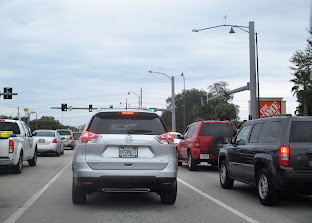
There's too much traffic.
 Those six-lane thoroughfares are choked with traffic, even out of season. And then, of course, winter arrives with its four-month infestation of SUVs from New York and New Jersey, Illinois and Indiana, Michigan and Massachusetts.

     It's too crowded. All those cars bring hordes of tourists and retirees who stand in line at restaurants, mob the amusement parks, overrun the beaches. Then out of season . . . the place is deserted. The condos are dark, the malls are empty, the beaches are a wasteland . . . yet, somehow, the roads are still choked with cars.

     Too many old people. I realize this is the pot calling the kettle black. Nevertheless, I don't think I'd like living in a place where everyone is as old as I am. I like living on our street where children play in their yards. I like going to a restaurant where young couples and groups of middle-age women liven up the place. I like walking around town and seeing teenagers bouncing into the ice-cream shoppe and young singles lining up at Starbucks.

     The algae blooms. You can't go in the water in Florida because of the red tide and other algae blooms. And now they've discovered something new: Sargassum seaweed on Florida beaches contains arsenic and other health hazards.

     Bugs, alligators, sharks and snakes. 'Nuff said.

     Too much crime. My sister told me when she comes to New York she's staying on the Upper East Side, where she'll feel safe. What I didn't tell her, but I know it's true, the crime rate in Jacksonville is higher than it is in New York City. And Jacksonville's not the worst. Miami, Daytona Beach,  Fort Myers all have more crime than Jacksonville.

     Lightning. Florida has been dubbed the lightning capital of the world, with an average of 1.45 million lightning strikes every year, more than any other state. It also has more deaths by lightning -- over 60 in the last ten years.

     Hurricanes! Florida experiences twice as many hurricanes as Texas, Louisiana or North Carolina. Hurricanes have caused billions of dollars of damage in Florida, and have killed dozens of people.

     No seasons. Florida has a semi-tropical climate. There are no bright colors of autumn, no pretty snowfalls of winter, no expectation of spring when the daffodils poke up and the forsythia start to bud . . . and most of all, there's no end of summer like there is up north when the heat and humidity break and the nights turn cool and you can finally breathe again.

     Is this beginning to sound like sour grapes? I'm not saying Florida is the worst place on earth. Think of the bright side. Florida has no volcanoes! (But there have been earthquakes.)  Besides, I have to admit, I like visiting Florida in the winter . . . and right now I'm jealous of my friend Bill. 
   

Saturday, March 5, 2022

What Doesn't Kill Us Makes Us Stronger

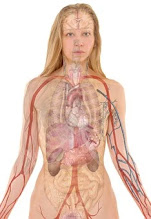
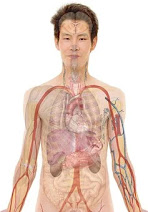
     It's a  dangerous world out there. The International Classification of Diseases (ICD) lists no fewer than 113 ways we can die. They range from the most common -- heart disease and cancer -- to other more obscure but still-lethal conditions such as whooping cough and meningococcal infection.

     Latest figures from the National Center for Health Statistics show that life expectancy in the United States currently stands at 77 years -- 74.2 for men, 79.9 for women -- which represents a decrease of 1.8 years from the pre-Covid era. That's the bad news.

     The good news is that this is the first time life expectancy in the U. S. has decreased in modern times. Over the years our life expectancy has gone up dramatically. For comparison, in our grandparents' day, life expectancy was roughly 62 years -- or 15 years less than it is now.

     Of course, how long we live depends on who we are. Most of us make it to our 70s, but not all of us. A dozen people from my high-school class of 105 students have already passed away from one cause or another. And averages don't say very much. On average my wife's parents lived to age 75 -- her father died in his late 40s, her mother lived to age 103. 

      Women live longer than men. Whites live longer than blacks. Hispanics live longest of all. A black male has a life expectancy at birth of just 72 years. A white female can expect to live to 83, and a female Hispanic has a life expectancy of 84. Meanwhile, those of us who have already made it to 65 can expect to live another 20 years or so -- a little more for women, a little less for men. And a few of us will make it to 103.

     Last year's decrease in life expectancy was largely due to Covid-19 which has killed almost a million Americans (953,000 at last count). For the past two years it has been the third leading cause of death in our country, after heart disease and cancer.

     (Death by vaccine, or vaccine-related problems, is possible, but extremely rare. Also, the idea that vaccines cause autism is fiction. The only study ever linking the two was shown to have faulty data, and the lead scientist fudged the results.)     

     Anyway, in addition to Covid, other causes of death have also increased in the past two years. The biggest killer, especially in our age group, is heart disease. Deaths from heart disease have increased by 4%. Why? No one knows for sure. But it's likely because people have been avoiding going to the doctor due to the restrictions of Covid.

     Deaths by "unintentional injuries" -- including suicides, car accidents and drug overdoses -- have also increased in the past two years. The stress, the boredom, the ennui and loneliness brought on by self-isolating have all contributed to more common and more severe mental-health problems.

     So for those of us who have survived Covid, I guess the message is: go to the doctor. We need to get our checkups and usual medical tests . . . and pay attention to our mental health, whether it involves meditation, yoga, long walks in the woods -- or consulting a mental-health professional if we're feeling that things are getting out of control.

     Let's all hope the worst of Covid is behind us -- and we can resume our normal lives and live out our expected lifespans, knowing that what doesn't kill us makes us stronger.

Friday, February 25, 2022

The Re-entry Cold

      I've developed a terrible disease. No, it's not Covid. I've been careful with the masks. I've taken all the vaccinations, avoided crowded indoor spaces.

     But there's another disease out there. And we are all vulnerable, especially since we've masked ourselves away from the usual bugs and germs that live in our environment. It's the simple, old-fashioned cold.

     The background: In February we came to Charleston, SC, to visit children and grandchildren. The kids have been careful. They have all been vaccinated. The grandchildren don't even go to the playground for fear of being exposed to Covid. They do go to preschool, but both teachers and kids wear masks.

     However these grandchildren are age two and four. And if you know anything about two and four year olds, you know they have runny noses. Pretty much all the time.

     So my wife is wiping their noses. And pretty soon she's wiping her own nose -- and coughing and hacking and feeling terrible. She tested for Covid, but the results were negative. Just a cold. She spent three or four days confined to the house, two of them never even getting out of bed. It was the worst cold she'd had in ... well, she couldn't remember when. She's mostly better now. But it's been two weeks, and she's still coughing.

     When she came down with the cold I took no chances. I moved into the guest bedroom. I used a different bathroom. I washed my hands about every ten minutes. Just maybe I could avoid getting this disease.

     But still, we ate dinner together, watched TV together, and when she started getting better we spent some time together in the car. And sure enough, by last Wednesday I could feel something. By Thursday I knew I had the cold. But it wasn't too bad. Sometimes, we thought, the second person in the household to catch the cold doesn't get it as bad.

    Wishful thinking. I spent Saturday in bed, popping DayQuil and listening to my wife cough in the distance. On Sunday I could barely move. My throat was raw from coughing. My head ached from the fluid in my sinuses. It was horrible.

     I thought I might have turned the corner by Monday. But then ... why couldn't I muster the energy to roll out of bed? I couldn't eat a thing. I tried to drink water. You're supposed to drink water. Man, I felt like I was drowning.

     Now it's the end of the week. I am finally starting to feel a little better -- just in time to go home. I feel like I wasted a good portion of my vacation -- didn't see the grandchildren for a week -- and of course the days I was in bed were the days when the sun finally came out and temperatures started to climb into the low 70s.

     Was this a particularly virulent strain of the cold virus? Maybe. But we wonder if all our social isolation, all our mask wearing, meant that for two years we were never exposed to any germs. Our immune systems were out of practice. They forgot how to respond to a normal, common virus. So when a garden variety cold comes along, we are sitting ducks. We have nothing to fight off the virus. And we were laid low.

     The consolation is that now, hopefully, our immune svstems are back in shape. We've had our re-entry cold. Now we're ready for real life when we'll be exposed -- and able to fight off -- the normal germs and common colds.

Saturday, February 19, 2022

We Are Old But Are We Wise?

      Older people are supposed to be wise. I think our current crop of seniors has lost some of that reputation -- partly because many older people don't keep up with technology. Younger people make fun of us for not knowing how to work the newest gizmo in the car, for not following the latest social media site.

     We don't know the hippest trends in fashion, movies or music. Were you familiar with the entertainers who sang at the Superbowl? Even stodgy old IBM is reportedly pushing out older workers, calling them "Dinobabies."

     Of course young people probably made fun of their elders back in caveman days for not embracing the newest styles in cave art, and not appreciating the latest design in spears and clubs. But the pace of change is so much faster now. Skills become outmoded. Attitudes become set in stone.

     But does wisdom really involve keeping up with the latest trends? What do you think it takes to achieve wisdom, to be wise?

     I think a wise person first and foremost provides perspective. Older people see things in the context of a larger picture and focus on what's actually important. We don't love our smartphone. We don't love our car. They are just things. They don't love us back.

     We love our children, grandchildren and friends, realizing they are much more rewarding than anything we can purchase. We appreciate experiences more than acquisitions. We know it's important to focus on truly fulfilling things like love, joy, knowledge, memories.

     We also also know some history. We don't panic at the latest news event or daily depressing statistic. We've seen it all before and realize that progress takes time. But we know it happens. That's why so many of us volunteer to help out in our communities -- because it makes a difference.

     Think not just about our longer life expectancy but also the improvement in our daily lives, thanks to everything from knee replacements and heart medications to developments in social and psychological attitudes. And as dangerous as our world is today, it's certainly less perilous than it was during World War II or the Cuban Missile Crisis.

     We also know it's important to have a skill or two, and to keep learning even as we get older. Our brains never get full. As we learn more, what isn't important eventually recedes to the background, but still provides a foundation for incorporating new information into something resembling real truth, rather than passing fancy.

     I think the wise person is skeptical, but not cynical. The cynic takes a dim view of everything. The skeptic is open to new things, but not before testing the veracity of fresh ideas, the sincerity of new people. The wise person is unlikely to fall for the latest demagogue, the newest health panacea, the fad diet.

     We are also aware that we can't research everything ourselves and we choose to believe accepted experts, not the TV huckster or internet sensation. We don't automatically accept that someone is as brilliant as they claim, and we're not necessarily impressed with status or diplomas.  But we don't place ourselves above anyone else either. We are willing to admit we're wrong, willing to accept new points of view.

     The wise person also knows their limits, and will push them, but not gamble their future on untested theories or ideas. Sure, we make mistakes, but we achieve wisdom by learning from our mistakes, not endlessly repeating them. It was John Foster Dulles, secretary of state under President Eisenhower, who told us: "The measure of success is not whether you have a tough problem, but whether it's the same problem you had last year."