"I can't be a pessimist, because I'm alive. To be a pessimist means that you have agreed that human life is an academic matter." -- James Baldwin
Showing posts with label Memoir. Show all posts

Sunday, October 23, 2022

My Useless Skills and Knowledge

      Admittedly, our children and grandchildren know more about technology than we do. They can play enormously sophisticated video games. They know how to Snapchat and TikTok, they can upload photos on iCloud and text using their watch. They can pay for a purchase in the store just . . . just by thinking about it.

     But there are plenty of things I can do that they can't. And plenty of things I know that they don't. They're not smarter than I am. My skills are more like fine wines . . . they've been aged and matured and are only appreciated by the, uh, the cognoscenti. 

     For example . . .

     I know how to iron.

     I remember my telephone number when I was a kid:  PE8-3840, no area code needed. My kids don't know anyone's telephone number. All they know is how to tap in a name.

     I can balance my checkbook.

     I don't know a Mocha from a Macchiato or a Costa Rica Naranjo from a Sumatra Clover. But I do know how to make instant coffee.

     I know how to write cursive . . . and I know what cursive means!

     My kids might be able to name the band members of Glass Animals or Chubby and the Gang. But I know the names of The Mamas and Papas. And the first names of Crosby, Stills, Nash and Young.

     I can identify where Quemoy and Matsu are located on the map.

     I can drive a stick shift.

     I can fold a newspaper in half, and then halves again, so it doesn't hit your seatmate in the face on the bus or commuter train. 

     I know how to play Scrabble (but not Wordle).

     I can read a map.

     I know what Mercurachrome is . . . and still have some in the bathroom medicine cabinet.

     Okay. Your turn. What useless skill -- or useless knowledge -- can you brag about?

Saturday, November 27, 2021

Ghosts of Thanksgiving Past

      After Thanksgiving dinner was safely tucked under our belts -- standard fare of turkey, stuffing, mashed potatoes, peas, cranberry sauce -- we joined our family on Zoom and started reminiscing about Thanksgivings past. Most of the memories were fond ones -- of mini-vacations, family get-togethers, convivial dinners and good food. 

     I recalled one Thanksgiving, back in the 1970s, when my wife and I were vacationing with a few friends. Nobody wanted to cook, but being in our 20s we didn't plan ahead, so we couldn't get a table at a restaurant . . . that is, until we found a Chinese place tucked into the back of a mini-mall. We walked into an empty room, with 20 or so empty tables, and proceeded to enjoy a great meal with great service. The cuisine seemed a little out-of-place for the occasion -- I had the pu pu platter -- but we all had a wonderful time laughing and joking about our sudden and unexpected cultural adventure.

     My sister remembered with a laugh the frozen string beans our mother used to overcook. I recalled the cranberry sauce plopped straight out of the can -- and the sweet potato casserole drenched in sauce and decorated with little marshmallows.

     "Speaking of marshmallows," my wife said, "did you guys ever have Jello with fruit in it? We used Mandarin oranges. with marshmallows and sometimes sour cream on top."

     "Oh, we had that stuff," said my daughter. "It was terrible. I also remember the turnips and mashed potatoes." She wrinkled her nose. "Mom used to mix the turnips in with the mashed potatoes -- thus completely ruining the mashed potatoes!"

     But then my son recalled how he loved to sit around in his pajamas on Thanksgiving day, watching the Macy's parade and helping his mom tear apart the bread and prepare the stuffing -- and how great it tasted after it came out of the turkey.

     "Yeah," my daughter added. "And I loved drowning everything in gravy. Mom made really good gravy."

     Then my other sister recalled, "Well, our mother wasn't much of a cook. But in her defense, she made a great leg of lamb -- not for Thanksgiving, but usually for Christmas."

     I remembered the leg of lamb. I don't even like lamb anymore, but I did back in those days. I liked the lamb and the roasted potatoes and all the other trimmings -- and just the fun and the warm feelings you get sitting around the table with eight or ten or twelve family members.

     "And remember Mom's hard sauce?" my sister added. "How did she make that? I think it was basically butter and sugar. It might've had a taste of vanilla and maybe some nutmeg."

     "And a drop of rum," I added. "Don't forget the rum! But . . . what did we put it on?"

     "Pecan pie," she said.

     "No, pumpkin pie," I corrected. 

     "Maybe fruitcake," added my other sister.

     "Oh, God, not fruitcake . . . spare me the fruitcake . . . "

     And thus it went. Another Thanksgiving full of family fun and fond memories. And now it's on to Christmas . . . 

Saturday, October 30, 2021

For Women Only

      I recently attended a book festival where I heard author Maya Shanbhag Lang talk about her book and her life -- her pregnancy, her daughter, her mother and her mother's journey into Alzheimer's. The book is a memoir called What We Carry, and I recommend it to all women, especially women who are around our age.

     I usually don't recommend books. For one thing, most people aren't interested in books -- or at least not interested enough to read them. According to the Department of Education fewer than half of Americans adults are proficient at reading. A quarter of Americans admit to never reading a book. Many others say they read or listen to just one book a year. The average book reader gets through four books per year. But the average is skewed by a few avid readers -- mostly college-educated women -- who go through a few dozen per year.

     I guess I'm a pretty avid reader. But honestly, most of the books I pick up are not academic tomes or serious literature. I gravitate toward mysteries from people like Michael Connelly and Robert Crais . . . and yeah, I admit it, I have gone through Sue Grafton from A is for Alibi to Y is for Yesterday

     Sometimes I read history (like The Splendid and the Vile by Erik Larson), but my latest finds are George Pelecanos, who sets his stories in Washington, DC, and Stephen Mack Jones who prowls the streets of Detroit.

     So reading Maya Shanbhag Lang was a stretch for me. It's a memoir mostly about her mother, a doctor who immigrated from India.

     To be honest, I didn't much like the first half of the book. The author drones on, charging her father with abuse, complaining about her mother's neglect, moaning about her depression.

     But then her mother starts to develop Alzheimer's. About halfway through the book the mother moves in with Maya and her husband and young daughter. That's when Maya begins to unravel the myths and false stories of her mother's life, and gets to know the real person with all her strengths and frailties.

     Eventually Maya and her brother (who doesn't do much to help) decide to put their mother into an assisted-living facility. This changes things yet again. Maya finally accepts who her mother really is and begins to appreciate all her mother has done. Maya struggles to understand the idea of home, the reality of love, the tension between self care and caring for others. This new relationship also influences how Maya sees her own daughter and affects her emotional reaction to the demands of motherhood.

     Like I said, most men will probably not be interested in the complexities and emotional ups and downs of this mother/daughter relationship. But I think a lot of women will identify with her journey. If I'm wrong, in my next post about books I'll gun for mysteries which, by all evidence, are more closely handcuffed to my own guilty pleasures.

Saturday, July 10, 2021

What Was Your First Car?

     Occasionally we look back and remember . . . our first car.

     My parents were General Motors people, and they thought Buicks were the best (except for Cadillacs which they couldn't afford). So we had Buicks when I was growing up.

     The first car I ever drove was a 1961 Volkswagen Beetle. Red convertible. Stick shift. No radio. That was the first "second car" my parents had. They bought it used for my older brother and sister, and eventually I got to drive it when they weren't around.

We had one of these
     At one point, I don't remember exactly when, we had a Nash Rambler. That was one terrible car. It had a push-button gear shift, and labored mightily to climb even the most mild of hills. 

     The first car I ever owned was a 1971 Volkswagen 411 stick shift. It had a weird heater that always smelled like gasoline. My wife and I bought it, used, for $1,965 in 1975 when we moved out of the city.

     My first new car was a 1977 Saab 99. It cost $5,200 (as I remember.) Stick shift, manual windows, am/fm radio, no air conditioning.

     Today my wife and I have a 2015 Subaru Forester and a 2018 Volvo S60.

But never one of these
     You might ask: Haven't you ever bought an American car? Yes! We had a Ford Taurus wagon to carry around the kids in the 1990s.

     I was going to boast that I've never owned a gas-guzzling SUV. I guess that's not quite true, since B has that Forester. But it does get close to 30 mpg on regular gas.

     Enough about my reminiscing. What was your first car? Or your family's first car? Or your favorite or most memorable car from back in the day?

Sunday, November 3, 2019

A Night to Remember

     This happened to me a couple of years ago. It was sometime in November, which maybe explains why it haunts me to this day.

     It was a cloudy, overcast morning before Thanksgiving. I was still groggy from sleep, and as I drank my coffee I recalled how I had just seen my old friend Phil.

     I'd been sitting in my office at work, behind my desk, looking out through the glass wall. Someone had pasted a notice on the outside of the glass, so I stood up to see what it was. As I circled around my desk, Phil appeared at my doorway -- tall and thin with bushy black hair and a big smile. He came in as though nothing had happened. He was walking a little funny, but gave me his usual throaty laugh.

     "Phil!" I said in astonishment. "You're here!"

     "Yeah, I was just down the hall," he said, pointing outside my door. "Thought I'd come by and say hello."

     He had some papers tucked under one arm, and set them down on the corner of my desk. And that's when I noticed he was using crutches. They were metal, the kind that go halfway up your forearms.

     He caught me looking at the crutches. Then he looked me straight on, with a sly grin on his face. "Yeah, I recovered," he said, acknowledging what I knew. "I'm okay, all except my legs. They don't work too well so I have to use these crutches."

     "Wow," was all I managed to say.

     "It's not too bad," he said reassuringly.

     I still couldn't believe he was here. But his laugh was real, for sure. I looked down at the papers he had dropped on my desk. They were written in some kind of Chinese characters. "That's great, Phil," I said, trying to regain my composure, trying to be cool about it . "So what are these papers?"

     "Oh, yeah, I've got to hand these out to some people," he said. Then, seeing I was puzzled by the strange lettering, he explained, "I've been doing a lot of traveling."

     "That's good," I replied. "Where to?"

     "Well, I've got to get going," Phil said, ignoring my question. Then as he turned to leave, he dropped one of his crutches, but he kept right on going, walking out the door leaning on one crutch and turning the corner. I bent over and picked up the crutch. It was cold in my hand. Then Phil peeked back around the corner. "Oops, forgot my crutch," he chuckled.

     I took a step over toward the door and handed him the crutch. He reached out and took it, then slipped it onto his arm. He turned and hobbled out. "Good to see you," he called over his shoulder as he disappeared down the hallway.

     So what really happened? It took place about ten years ago. Phil came over to the office. He was going to treat me to lunch. He was a few years older than I was and had taken an early retirement package from the company. But he lived nearby and often came by to see old colleagues. He'd told me he'd pick me up; he'd be happy to drive. My office was right by the front door, so that day he pulled up in his Corvette and honked. I saw him out my window, and he waved to me.

     I threw on my jacket, rushed out the door and jumped into the passenger seat. It was an old Corvette. He'd bought it for his wife on her 40th birthday. But by this time she'd gotten a new car, and he was driving the Corvette . . . for sentimental reasons, I think.

     As we headed over to the restaurant we talked about our friends and joked around about various things going on at the office. But I noticed, as he drove, that he handled the steering wheel kind of funny. Was something wrong? I wondered. I didn't say anything. He was talking like the same old Phil. How could anything be wrong?

     Again at lunch, it seemed as though he was awkward -- was there something the matter with his hands? I wasn't sure, and decided he should be the one to bring it up if he wanted to, so I kept my mouth shut. Still, I searched his eyes for some kind of recognition, trying to offer a non-verbal signal that it was okay to tell me if something was wrong. But he didn't pick up on it. His conversation, his attitude, his demeanor all said that everything was fine.

     We finished lunch and Phil dropped me back off at work, laughing and joking and promising to meet up again soon. "So long," I called to him as I closed the car door.

     "Bye bye," he waved.

     It was the next day when I heard the news. Phil was dead. He had committed suicide. He had written a note to his wife and daughter, gulped down a bottle of pills, lay down in bed and died.

     Why? What happened? Everyone wanted to know.

     Phil had Amyotrophic Lateral Sclerosis (ALS), also known as Lou Gehrig's disease. Nobody knew about it except his family. He'd been hiding it. It's a progressive, fatal disease. No cure. No way out. We could only guess what went through his mind -- that he didn't want to be the object of sympathy from his friends, that he didn't want to become a burden to his family, didn't want to subject himself to the indignities of the inevitable heartbreaking decline.

     So he'd ended it on his own terms.

     Phil, I don't know if you did the right thing. Who am I to judge? But, damn, you had a lot of courage. It's been over ten years and I still miss you. But thanks . . . thanks for coming to visit me in the night in my dreams.

Saturday, December 1, 2018

The Fist Fight

     My dad grew up in an immigrant family. His mother and father came from Austro-Hungary in the 1890s. I never met my grandfather -- he died before I was born -- but my grandmother was a fierce woman who spoke only broken English, but was bound and determined that her children would grow up and succeed in this new country.

     We called her Grammy, and I only knew her as a fat old lady. But in her day she must have been a proud woman. She and my grandfather bought a house sometime around 1910. It was a two-family rowhouse, in the ethnic neighborhood of an old industrial city in New England, but still, it was a house. And she was proud that she was heavy -- it meant she could afford to eat!

     She had seven children altogether. Uncle Johnny was the oldest surviving boy (the first son died in the 1918 Spanish flu epidemic), and he must have been smart, although I remember him more as being aggressive and pugnacious. My dad was the next son. He was more reserved and studious. Grammy used to tease him because he was ranked 2nd in his high school class . . . and he was beaten by a girl!

     But somehow, through luck or persistence, or maybe a kind of early affirmative action, my Uncle Johnny got a scholarship to the nearby Ivy League college, and went on to become a lawyer. My father followed in his footsteps. They both bought nice houses in the suburbs, had healthy families, and went on to send their children to good colleges.

      But the third son had a rougher time of it. He'd suffered from polio, and he had diabetes and probably some other ailments as well. He went to a community college in New Jersey and became a teacher, back in the days when teachers made no money. He and his wife had a side business restoring antiques, just to help make ends meet. Uncle Fred walked with a cane, and his face was creased with long, deep furrows.

     Uncle Fred lived on a dirt road with his wife and son. When we went to visit them in the summer the kids would go swimming in a nearby creek, with an old tire on a rope so we could swing out into the water. It was a lot of fun.

     Fun for me. But Uncle Fred held some resentments. The whole family used to get together at my aunt's house in rural Connecticut a couple of times a year. So this incident happened over Easter. I think it was 1965.

     I was in high school, just beginning to get tired of going to the family get-togethers. And a little embarrassed, too. I lived a suburban white kid's life where everyone lived in nice houses with green patches of lawn. The men donned suits to go to work, the women wore dresses, and everyone was polite and proper. But my father's family still had some rough edges. They drank and got loud and talked in the strange mixed language of my grandmother.

Uncle Johnny (left) and my dad, c. 1940
     My grandmother was the roughest of them all, ordering her sons around, telling them what to do. My own mother did not like Grammy. "She never thought any woman was good enough for her precious sons," she said with some bitterness.

     So it was that year that Uncle Johnny's son, my cousin, flunked out of college. And not just any college. He flunked out of his father's Ivy League college.

     So we were all sitting on the stoop outside my aunt's house. Uncle Johnny looked over at his younger brother, Uncle Fred. Maybe Fred could help out, he thought, maybe Fred could use some influence and get his son into his no-name college in New Jersey for a semester or two, until his son got back in good graces with his fancy Ivy League school. At least his son would be somewhere in college, not hanging around home causing trouble.

     I'm sure Uncle Johnny was just trying to be a good dad. But Uncle Fred bristled at the idea. "Are you kidding?" he snarled at his older brother. "Where I work, where I went to school . . . it was never good enough for you. But now your kid gets in trouble, and you come crawling to me for help? Where were you when I needed a little help?"

     "Oh, you're full of crap," Uncle Johnny shot back. "I helped you for years. Gave you money to get that house of yours built. Now I'm asking for a little favor. Just put in a good word. He needs to go to school. No skin off your neck."

     Uncle Fred put down his drink and stood up. "You got a lotta nerve. . ."

     Uncle Johnny stood up and faced him. Looked him hard in the eyes, challenging him. Uncle Fred took a step forward. Then he pushed Uncle Johnny back so he stumbled on the step. Johnny turned and bent over, thrusting his arms out to catch himself on the concrete step. Then he whipped around and lunged at Uncle Fred, throwing punches to his body and tackling him to the ground.

     Uncle Fred rolled over, got on top and was landing some blows -- even though he was handicapped he was still ten years younger. But then Grammy banged out of the front door. She stood imperiously on the front porch, looking down at them and yelling to stop.

     My two uncles obeyed immediately. They got up and dusted themselves off. Uncle Fred labored up the steps and went into the house. Uncle Johnny's hand was bleeding, scraped on the concrete stairs when he fell on the porch. He laughed it off, sneering, "Oh, gripes, he'll never learn." He picked up his drink, took a swig and looked around at four or five of us kids, sitting slack-jawed on side of the driveway. We thought only kids fought; we didn't know that adults could fight as well.

     "Come on, get the baseball, let's go play some catch," Uncle Johnny said.

     By the end of the day everything was back to normal. My uncles were slapping each other on the back, laughing and apologizing. "Nevermind." "Don't worry about it." "No hard feelings." We then herded into our cars and started on the trip home.

     As you might have guessed, Uncle Johnny's son never went to school in New Jersey. Instead, he went into the military. He learned to fly airplanes and eventually went back to college, got his degree and became a computer analyst. Now he's retired in upstate New York and likes to ride motorcycles. Me? I still live in the suburbs.

Wednesday, September 12, 2018

Whew ... I'm Glad I'm Retired!

     My town of Doylestown, Pa., holds a bicycle race every year called the Bucks County Classic. It took place this past weekend. There were events for children, for women, for amateurs and professionals. One of the events this year was the Brompton Burst.

     In case you don't know, the Brompton is a folding bike made especially for people commuting to work. You can ride it to your office, or the commuter train, then fold it up into a carrying case and stash it in your closet, the trunk of your car, or wherever you want to store it.

     Brompton Burst participants are required to wear business attire. (There's a prize for best dressed.) The race has what's called a Le Mans start, which means when the race begins, everyone runs to their bike, unpacks it, sets it up, then rides five laps around town. The track is about 1.3 miles -- so the race is a little over six miles long.

Notice the tie ... and it's raining

     It's supposed to be a fun, oddball event, a warm-up for the professional bike race. But the truth is, the event just reminded me . . . I'm glad I don't have to commute anymore, whether on a Brompton bike or any other way.

     When I commuted to a job in New York City, my official hours were 10 a.m. to 6 p.m. I never minded going to work early, if I had to, because there were plenty of earlier express trains. But I hated to work late.

     The last express train left Grand Central at 6:33 p.m. And my office was a comfortable 15 minute walk to the station. But once or twice a week, work would spill over past 6 p.m. There was a meeting or I needed to make a deadline. I knew I had to leave by 6:15 to make that last express comfortably. If I left at 6:25 I could still make the train, but only if I ran most of the way.

     I still remember nervously watching the clock. If it slipped past 6:25 I knew I'd miss the express. The next train wasn't until 7:05, and it was a local that took 52 minutes instead of 39 minutes. It meant I'd be getting home almost an hour later than usual -- sometimes because a meeting went ten minutes long.

The professionals take their turn

     And I still remember the many times I'd dash out of the office at 6:22 or 6:24 and, in full business attire, swinging a fully loaded briefcase, go sprinting down Sixth Ave. and across 45th St. to make that express train. In winter it was bad enough, slipping on the rainy pavement. But summer was worse. I'd leap onto the train, elbow my way to an empty seat, and as the train pulled out of the station I'd be breathing heavily, and I'd feel the sweat dripping off my face, soaking my suit, making me feel sticky and itchy all over. 

     So like I said . . . I'm glad I'm retired!

Tuesday, August 22, 2017

A Dimming of the Light

     I don't know where you were during the eclipse. I was out on the golf course, in New York, where the moon covered 70 percent of the sun. But, honestly, the effect was minimal. We had some high whispy clouds, but nothing really covering the sun. The sky got slightly darker; the light turned brilliant like late afternoon; and then it was over.

     I was on my way home from attending a memorial service for my friend Joe. His ashes were buried at sea . . . or really, about a mile off the Rhode Island shore, near the Point Judith lighthouse. A lovely ceremony, with family and close friends. Then a larger gathering later on, with a few more people.

On a South Carolina golf course, circa 2009.
     Of course, it makes us think about how we ourselves would want to go, where we would want our remains. Both my parents were cremated, and their ashes are buried at their retirement home in Florida.

     My sister and I went down there once, a few years later, to view the site. But it didn't do much for me. It just didn't feel like my parents were there. It might be different if we had a family burial place. But we don't.

     The ship captain gave the family the exact coordinates of the burial spot. I don't know if they'll ever go back out to see it again . . . or if he'll still be there.

     But it was nice to get together with three old friends, the day after the service, to play a round of golf in honor of our departed colleague. He was a golfing friend, but also a work friend, a poker friend, a lunch companion. He held great Fourth of July parties -- he had a swimming pool and risked life and limb to light up a fireworks show every year. We vacationed together in South Carolina; our kids didn't know one another, but they were the same age, so we followed them growing up, going to college, getting married. And now his older daughter is pregnant.

     To tell the truth, he was a lousy golfer. But my world will be a little darker without him. He was a great guy, and would have made a wonderful grandfather.

Friday, January 16, 2015

Bittersweet Memory

     When you're on vacation you have a lot of extra time, sitting on the beach, hanging around the pool, lounging on the deck. Believe me, I'm not complaining, but sometimes your mind wanders and you get to remembering about things at home, events in your past, about your family . . .

     It was early one morning toward the end of August. My ex-wife and I bundled our daughter into my old Saab, along with a trunk full of bags and suitcases, and left for JFK airport. At the time my ex-wife, Jane, and I lived around the corner from each other in one of the NewYork suburbs, about an hour's drive from the airport.

     Our daughter was catching a 7 a.m. Jet Blue flight to San Francisco, heading back to California for her senior year in college.

     The sun rose as we came to the end of the Hutchinson River parkway and climbed onto the Whitestone Bridge. "Good flying weather," I announced, as a few wispy clouds caught the first rays of light in the deep blue sky. We had a panoramic view of Manhattan off to the right of the bridge. Even though it had been three years since 9/11, the skyline still looked empty without the Twin Towers, especially on a day like today, with the sky so clear and blue.
 
     Emily had made this trip to college a dozen times, and she knew the drill. I didn't want to have to park the car out in the lot, with a $15 charge and a 15 minute walk. So I would pull up to the Departures curb, Jane would rush into the terminal with Emily, get her settled, and then meet up with me to go back home after I drove around the airport loop.

     As soon as we arrived at the Jet Blue terminal Emily jumped out of the car and ran around to the trunk to grab her bags. I opened my door, climbed out and helped her haul the suitcases onto the sidewalk. "Got your ticket?" I asked as she zipped a book into her carry-on.

     "Yep," she affirmed.
  
     "And your driver's license for ID?"

     "Yep."

     I helped her drag her bags up to curbside check-in, where Jane had gone to stand in line. Emily gave me a quick hug, and I turned to go. One of the traffic cops shot me a dirty look as I walked back to the car, idling at the curb, but I nevertheless stopped and looked over the roof of the car, taking a moment to watch Emily and Jane.

     My ex-wife was short and a little hunched over. She had long blonde hair hanging down in front of her shoulders, covering part of her face. That was an intentional look. She liked to hide behind her hair. At that moment she was standing there, peering anxiously through her hair to the front of the line.

     I caught sight of Emily, bent over a suitcase making last minute adjustments to her baggage. Emily was always in motion, doing two or three things at once. Her copper-colored hair -- the color it got from overexposure to chlorine in the swimming pool -- swung back and forth as she moved her head and shoulders. She looked purposeful, confident, eager to get on with school and life.

     I opened the car door, slid into the front seat, yanked off the parking brake and started down the ramp from the Departures building. I drove out about three miles to the return lane next to the airport police station, then circled back to the Jet Blue terminal. By then, maybe eight or ten minutes later, Emily had disappeared inside the building and Jane was waiting  for me at the curb.

     She pulled open the door and climbed in the front seat. "So, everything went okay?" I asked her.

     She didn't answer.

     "Did you get Emily to the security gate?"

     Still no answer.

     "Is there a problem?" I pressed.

     "No, everything's fine," she finally replied, staring straight ahead through the windshield. I checked the traffic and started to pull away from the curb.

     Then she burst out crying.
    

Tuesday, August 5, 2014

A Piece of the In-Crowd

     When I was in junior high school, and in high school, there was nothing I wanted more than to be part of the In-crowd. The idea consumed my life. I tried to hang out with the "in" people as much as I could -- as much as they would let me -- and I felt a deep hole in my stomach when I was left out of one of their activities.

     Honestly, I don't know why I was so obsessed with that crowd. Most of those people didn't do much that was very interesting -- although as we got a little older they were the ones who had parties, where you could drink as much Coke as you wanted, eat as many potato chips, and slow dance with the coolest, best-looking girls.

     Maybe it was the chance to slow dance with the best-looking girls. For the best looking girls definitely formed the In-crowd on the female side of the aisle, led by Julie, the prettiest girl in the class. But, honestly, must of those good looking girls were not particularly interesting or smart or unique in any way -- although, to be fair, Julie was nicer to me than she ever had to be.

     There was one girl, though. Her name was Sharon. She had striking reddish-blonde hair and ... well, she had developed physically, which captured the attention of the boys in junior high. She was definitely part of the In-crowd.

     Obviously, I was attracted to Sharon, and was thrilled when we were assigned to be lab partners for biology class, which we took in 8th grade because we were in the honors section.

     In our third or fourth lab session, the teacher introduced us to the concept of cells. I remember standing there at the lab bench next to Sharon, when the teacher directed one member of each team to swab the inside of their mouth with a little stick. Sharon volunteered to be the swabber for us. And so she took the stick, opened her mouth, and wiggled the stick inside her mouth, scraping off some cells from the inside of her cheek.

      She took the stick out and proudly held it out to me. There was the stick, with this glob of goop hanging off the end, all drippy and shiny and looking kind of like snot.

     I took one look at it -- and immediately lost my attraction to my lab partner. But that was actually a good thing, because from then on I could concentrate on biology instead of Sharon. And as I remember, we both went on to get A's in that class (well, Sharon did anyway).

     It was also in 8th grade when I caught wind of a rumor. The four coolest boys in our class were forming a club. They called themselves The Mamas. They let it be known that they had a secret handshake, and met together after school. Of course, all this made them even cooler than before.

     As soon as knowledge of The Mamas got out, another group of boys who were almost as cool decided to get together and form a second group which they called The Papas. One of the boys, Larry, approached me to see if I'd be interested in joining The Papas. I was thrilled to be asked and told Larry, sure, count me in.

     But a day or two later, Larry found me in the school hallway, and informed me that they'd decided to offer someone else the fourth spot in The Papas. I was out. I was rejected. Just one more leftover loser in 8th grade.

     A few days later another friend of mine, a neighbor named Mike, started making fun of The Mamas and The Papas out on the playground. He snickered at them -- not to their faces, but to me and another friend of ours, David, who lived up the hill behind my house. Then Mike suggested the three of us form our own group. I, of course, feeling rejected, jumped at the chance.

     We called ourselves the Three Little Pigs -- an obvious reference to the two groups that were more "in" than we were. But it was also obvious to everyone that we were making fun of the other guys who thought they were so very cool. Which, we thought, made us cool.

     The whole thing burned out in a few weeks, and was soon forgotten. But the next time we all convened for a party on a Saturday night, the lights went down, the slow song came on, and I summoned up the nerve to ask Julie to dance with me. I was floored when she said yes. And we slow danced under the dim lights for the length of the next record.

     But then, a few minutes later, I saw her with Larry. They were talking. And giggling. Then they were dancing. And I was back to drinking Coke and eating potato chips with Mike and David.

     Finally, when I got to college, I lost interest in trying to be in the In-crowd -- partly because there were too many people in college for there to be a single In-crowd. There were athletes who were cool; there was a theater group that thought it was cool; the kids who ran the school newspaper were cool in a certain way; and a lot of fraternity brothers thought they were super cool.
 
     I finally realized what I needed to do was not try to be cool, but to do my own thing -- which I eventually did, and found my own group of friends who liked me and accepted me, and who were interesting, and even cool in their own way.

      In other words, what I learned was, I'll always be a Three Little Pig.


Saturday, April 12, 2014

A Mustard and Ketchup Fight


      Some people have asked me about the mustard and ketchup fight I mentioned recently in Betting on the Minimum Wage. Here's the story.

     It was the summer of 1966. I was in high school and went looking for a summer job. I honestly don't remember how I found out that our local amusement park was hiring -- maybe I read it in the local paper; or my dad might have made the suggestion; just possibly I figured out for myself that an amusement park might need kids to work there in the summer.

     Anyway, I was hired for the minimum wage at the time of $1.25 an hour. I started working in a food stand in the park, selling fountain drinks, ice-cream bars, cotton candy. I was only working there for a few days when the manager -- did he recognize my innate talent, my executive potential, my high-class upbringing? -- asked me if I wanted to move into the main snack bar. It was considered a more favorable place to work (for one thing, no evening hours), and so I said yes, sir -- although there was no pay raise that went with the new job. I guess, these days, you'd call it a lateral move.

     The main snack bar was a big place out by the picnic tables. It opened early so park employees could stop off and get coffee and a bite to eat before the park opened. A lot of the employees came over to us for lunch as well, since we offered an expanded menu of hamburgers, hot dogs, grilled cheese, and fries.

     Also, since we were near the picnic tables, groups like a busload of kids from the city or a school class trip, would come over for their main meal.

     I learned a lot that summer. I learned how to make coffee in a big urn -- and it was pretty good coffee, too -- and I learned how to make hot dogs and grilled cheese sandwiches (the hot dogs were okay, the grilled cheese sandwiches were pretty awful). I learned how to stack inventory, a skill I use to this day in our kitchen at home.

Ready for action!
     I learned a lot about making change. It wasn't long before I didn't even need to count the money. I just knew if the charge was 60 cents, and I got a dollar, I pulled out a quarter, a dime and a nickel for change. If the charge was $1.20, I automatically handed back three quarters and a nickel as change for two dollars. Nobody ever gave me a $5 bill. That was big money in those days.

     However, I also got my first introduction to the unintended consequences of government regulation. The snack bar was open 9 a.m. to 7 p.m. Employees worked 9 hours, with one hour for lunch. But I was under 18, and so according to State of New York child labor laws, I was not allowed to work more than 8 hours. But instead of being able to come in an hour late, or leave an hour early, I got two hours for lunch. It wasn't enough time to go do anything, to leave the park and come back (besides, I rarely had my own car). So all I did was sit around for two hours and not get paid.

     The amusement park was about ten miles from where I lived, about a 20 minute drive. My family had two cars. My dad took a train to work. My mother had one car, and I had to vie with my two older sisters for use of the second car. So I didn't get to take it for the day very often. Instead, I usually carpooled with a fellow named Billy who lived near me. He was older, maybe 22 or 23, and going to college part time.

     The summer of '66 was a hot one. I remember being happy working out by the picnic tables, under the trees, where it was cooler, instead of in the middle of the park. I got to know kids who ran the rides, and I rode the big roller coaster a couple of dozen times. Then I got bored, and when I wasn't working I sat around the picnic tables and read books or magazines.

     About halfway through the summer I was asked to help out with the ice-cream truck. That was a lot of fun. The truck delivered ice-cream pops to the stands around the park. I got to ride on the front bumper of the truck. It stopped at each stand, while I jumped off, ran around to the back, and pulled out the ice-cream order for the day.

     There were six or eight kids who worked at my stand. Joe was the boss. He was a distinguished-looking older man -- tall and thin with graying hair, and he took the job seriously and ran the stand by the book. His assistant, Walter, was even older, and he was a fellow we could pretty much ignore.

     One August afternoon, we were all looking forward to getting back to school, back to our real lives. Business was slow. Joe was off doing something else in the park, leaving Walter in charge. I was sitting at the cash register, when Billy tumbled out of the back of the stand. He was laughing. A second later I saw a shot of red go flying over his shoulder. Then another kid came through the door. He was armed with a ketchup squeeze bottle in one hand, and a mustard squeeze bottle in the other.

     The kid squirted the mustard bottle. One line hit Billy in the shoulder; another missed him and landed on my pants. Billy grabbed a mustard container from the counter, turned, and fired back at his assailant. Then he shouted to me. "Come on, Tom. I need reinforcements!"

     Just then, another kid came out of the back, shooting with both hands, ropes of ketchup and mustard flying through the air. I grabbed a mustard and a ketchup, and joined Billy, fighting off the other two kids.

     Within seconds, four or five kids were running through the stand splashing mustard and ketchup all over one another, and also getting it on the counter, the floor, and a couple of customers. Walter was yelling, "Stop it! Stop it!" But, like I said, nobody paid attention to Walter.

     I remember running through the back of the stand, over to the other side, when Billy came up behind me. He vaulted over the counter and started shooting at someone. Just then, Joe walked into the snack stand.

     He put a stop to everything, real quick. Billy was fired. He was gone in less than an hour. So were a couple of the other combatants.

     I was not fired, I got away with a reprimand. Maybe it was because I was the youngest kid there, or maybe because Joe knew I hadn't started it. But I was demoted. I was taken off the morning ice-cream route, and put to work cleaning and scouring shelves.

     The incident occurred toward the end of August. I worked through Labor Day, then the park closed. I do remember, at the time I'd been hired, there'd been some mention of an end-of-season bonus if I stayed for the entire summer. I didn't get the bonus. That's another lesson I learned -- if you want your bonus, behave yourself. But at least I can say, I was never fired.


Saturday, November 2, 2013

I Don't Make My Bed Here Anymore

     I left work over ten years ago. And yet work is still with me. Do you still have dreams about your job? Are they happy ones, or nightmares?

     I had what I would call a middling successful career, working for four different companies throughout my life, not counting the jobs I had when I was still in school. Some jobs were better than others. Some were fun and rewarding at times, but boring and stressful at others.

     The last fulltime job I had -- the one I had the longest -- was with a book and magazine publisher. The actual work was mostly interesting, but the people could be difficult, especially during my last years when the company -- like a lot of print publishers -- was having problems. Management was always anxious, never knowing quite what to do about changing tastes and changing habits. They tried one strategy, then another, until they came upon one tactic that improved the bottom line, at least for a while -- what they called "right sizing," which as everyone knows means layoffs.

     The layoffs came in waves, usually once a year, sometimes twice a year, sometimes smaller waves, sometimes bigger ones. I especially remember 1996. That was a tidal wave. Somehow I was spared that tsunami and ironically, because the ranks were so thinned out, I was then able to work my way into more responsibility and got a promotion and was, briefly, even making more money.

     But be careful what you wish for. Now, instead of watching other people get laid off, I was thrown into the position of being the hatchet man. I vividly remember the four different occasions when I had to go into someone's office, carefully place the dreaded manila envelope that came from Human Resources on their desk, and tell them they were being laid off. Meanwhile, I watched with both regret and envy as a few other people quit their jobs, either to take early retirement or go to another job in different company.

    But in a declining company in a declining industry, that situation didn't last long. Eventually I was the one on the receiving end of the manila envelope, which I approached with a mix of panic and delight. Panic because . . . how was I going to support myself? I was well into my 50s. Who hires anyone in their 50s? And delight . . . because I was finally going to be delivered out of this poisonous, stressful and untenable situation.

     As it turns out, I was able to find my own way, making some money as a freelancer and consultant, and with my kids mostly grown up I had fewer financial responsibilities. So in retrospect, that day I was laid off should be counted as one of the happiest days of my life.

     But wounds leave scars. They remain with you, even many years later. I still have dreams about my old job -- they're not always nightmares, but they are usually disturbing.

     Last night I dreamed . . . I was lying in a bed in the corner of an office. Was I just waking up, or taking a nap? I'm not sure. But I remember the covers were all messed up, the pillow askew, the bedspread all crumpled up, the sheet trailing on the floor.

     I heard voices in an outer room, friendly voices, but they were discussing some sort of business issue. I got up and opened the door. My old boss was standing outside, talking with a group of colleagues. They were dressed in business clothes. I was wearing a t-shirt and pajama bottoms,with bare feet. But I wasn't embarrassed.

     The people in the group turned their heads to look at me, and offered a friendly greeting. I nodded cordially, then started to make my way out of the room, not back to the office with the bed, but out into a hallway.

     As I reached the door, my old boss casually called to me, pointing back into the office. "Tom, don't forget to make your bed."

     I looked over through the door and saw the bed, all in a jumble. A sudden realization came to me. And I laughed as I said, "I don't have to make my bed, anymore. Goodbye!"

Saturday, September 7, 2013

Lesson Learned -- Part 2

     Eddie Lynch gave me a hard stare, then his mouth curled up in a wolfish grin. He was looking for a fight, because he knew he could win.

     We were all now standing around on the sidewalk, everyone waiting for something to happen. I knew I couldn't back down, but I wasn't going to volunteer either. "Look, nobody's going to make you," I finally said. "Can't you take a hint? No one wants you around here. So get lost."

     Eddie edged forward, pushed past me and started to walk up the driveway.

     "Hey, stay out of here!" George piped up, his face flushing red in anger and frustration. "This is my yard. You can't come in here!"

     I followed Eddie in through the gate. Darby was on my heels. "What are we gonna do?" Darby whispered anxiously to me. "We can't let him do this to us. We've got to get 'em."

     "Okay, Eddie," I said, deepening my voice, trying to sound threatening. "Enough is enough. Get out of here now, will ya."

     Eddie turned around. "You gonna make me?" he challenged. He took a step forward, reached out with both arms and pushed me in the chest. I stumbled back a step. Darby caught me. "Get him, Tom," he urged. "Go for it."

     I stepped forward and gave Eddie a return shove. "Well, maybe I'm going to have to," I heard myself saying. But when I pushed Eddie he didn't fall back. He just stood there like a concrete wall.

     Eddie shoved me again. "Don't you dare touch me, you shit-eating pipsqueak." His tone had changed completely. Instead of sneering and taunting, he was suddenly threatening, and dead serious.

     I realized we had just crossed some kind of line. Eddie was not going to back off. And I couldn't, either -- not now, not in front of my friends. So I made a split-second decision. If we had to fight, the only chance I had was to strike first.

     I lunged at Eddie, grabbed him around his stomach and drove him to the ground.

     "Way to go!" Darby yelled. "Go get him, Tom!"

     It might have been better if I'd let Eddie have the first shot, because then the fight would have been over quickly. Instead, since I had the initial advantage, it took him a while to beat me up.

     He rolled out from my grasp, flipped me over and started pommeling my stomach and chest. I managed to get away, then tackled him. We traded blows. I was on top, then he was on top. We fought on the ground, and we fought standing up. But eventually his greater strength and bulk wore me out, until he finally drove me across the yard. I was stumbling backward. I almost lost my balance, but was saved by crashing up against the chain-link fence.

     Eddie came after me, throwing his body into mine and pinning me against the fence. Both my arms were trapped. Eddie had one of his arms around my chest while he jammed the other up against my throat. I tried to resist as he pushed up against my head, until finally my neck pressed back against the sharp metal spikes sticking up from the top of the fence. I was breathing hard, and every time I gasped for air the spikes dug into my skin. Eddie's face hovered just inches in front of mine; it was red and bloated, his skin puffed up in anger. His teeth were thrashing, and spit was flying out of his mouth.

     "Give up?" he shouted at me. "Do you give up, Tom? Do you give up?"

     I didn't know what to do. I could barely breathe.

     Then he started demanding, over and over. "Give up. Give up!" He applied more pressure to my neck. I was trapped between his piston-like arm and the metal spikes of the fence that would soon start to puncture my flesh and draw blood.

     "I give up," I finally managed to cough out.

     The pressure let up. Eddie abruptly turned and left. And I slumped to the ground.

     Everything was a blur of darkness and muffled noises. I could feel the cool grass on my back. I kept my eyes closed to shut out the world for a minute, to give myself a moment to recover.

     "Tom?" It was someone's voice. I didn't know who it belonged to.

     "Are you okay?" came another voice. This one belonged to George. I opened my eyes and saw a narrow slice of trees and sky. As I came out of the spinning darkness, it all seemed very bright and full of color.

     Then a head came into my field of vision. It was Darby. He had a quizzical look on his movie-star face. "Tom?" he queried. "Are you okay?"

     "Yeah, I think so," I managed to say through my constricted throat. "He had my neck on the fence," I said apologetically, fearing that I'd let my friends down. "I had to give up. The fence woulda killed me."

     Darby gave a little shrug. "Hey, don't worry. It doesn't matter." He reached down and helped me up. "But jeez, Tom . . .  you shouldn't have picked a fight with Eddie Lynch."


Thursday, September 5, 2013

Lesson Learned -- Part 1

     It's September. Back to school time. The crisp air brings back memories . . .

     Darby Gilman, George Elmore and I were best friends in grammar school, back in the 1960s. George was a budding scientist who spent most of his time experimenting with his chemistry set and taking care of his fish and turtles in his basement. Darby was a good-looking kid who had moved to our little suburban town from California. He was already enjoying success with the girls, even as the rest of us were trying to figure out what to do with these tall, skinny creatures who were beginning to hold some mysterious appeal -- and who now wanted to dance with us.

     But this story isn't about love. It's about a fight.

     And if George was the scholar in our crowd, and Darby the lover, then I was the fighter -- no testament to how tough I was, but more an indication of how scrawny my friends were.

     The three of us used to meet up in George Elmore's yard, sometimes with George's little brother and some other friends. We would play stickball and dodgeball in his driveway. We'd sit on his swings and talk about our families and our teachers. We'd lay on the grass and discuss Monopoly strategies or debate various theories about how women had babies.

     George's yard was bordered by an old-fashioned chain-link fence. Besides being centrally located, the yard gave us a secure place to gather, our own sanctuary that nobody outside the immediate neighborhood cared about or even knew about.

     When we got old enough for junior high school, we were thrown together with kids from other sections of town. Most of them were friendly, but one group of guys from across U. S. Route 1 was more interested in making an impression than making friends. In other words, these kids were looking for a fight.

     The crowd consisted of five or six fairly hefty guys, led by Eddie Lynch, the biggest kid of all. Eddie was an inch or two taller than me, with muscles that stretched his t-shirt across his chest and shoulders. He was later to become star of the high-school football team, and go on to play in college.

     Starting in September, Eddie and his friends came around to our street, probably three or four times. First they tested us, then they taunted us and began to intimidate us. Once when we saw them coming, we were reduced to hiding out in the Elmore's garage.

     Then, one sunny Saturday in late September, we were sitting on George's swings, discussing what strategy we needed to use against these guys. We didn't come up with much more than a resolution to not let them push us around. Darby, my friend from California, was especially vocal about protecting our own turf. "I'll get my older sister's friends," he vowed. "And we'll tear them apart."

     I didn't put much stake in Darby's plan. We soon got tired of our own bluster and moved to the driveway where we began a game of stickball. The driveway served as an infield; the garage door supplied a backstop behind home plate; the lawn was our outfield.

     If one of us hit the tennis ball over the chain-link fence into the street it was a home run. Home runs were rare, but someone occasionally grounded a ball up the middle and out the driveway. It was George Elmore who had made just such a hit and was rounding the bases. Darby was playing outfield and turned to run along the fence and then out to the street after the ball.

     Suddenly, Eddie Lynch was standing on the sidewalk, with three or four of his friends looming behind him. Eddie had picked up our tennis ball and was waving it at us.

     Then he began tossing the ball up and down with one hand. "Come and take it from me, Darbs," Eddie challenged, his mouth cracking into a grin. He started to laugh, and when he laughed little bubbles of spit formed at the corners of his mouth.

     Darby walked up to face him. Eddie extended his arm toward Darby and held out the ball. When Darby reached for it, Eddie flipped it to one of his friends.

     I walked out to the driveway entrance, along with George and his little brother. "Don't be stupid," Darby warned the red-headed, freckled kid who now had the ball. "You don't want to get into a fight over this."

     The red-headed kid didn't say anything, he just lobbed the ball over Darby's head to another boy in Eddie's crowd, a tall lanky blond fellow. They were all laughing and snickering.

     "Hey, come on," I called. "Just give us the ball. We don't want any trouble."

     Eddie stared at me. Then he scrunched up his face and squeaked, "Give us the baa-aall. We don't want any troo-uuble."

     Eddie turned to his friend. "Throw the ball," he ordered. And the kid tossed the tennis ball not to me or Darby, but to Eddie. Then Eddie Lynch reared back and hurled the ball over the fence, across the corner of George's yard and down the street.

     I turned and watched the ball fly. It gave a big bounce on the sidewalk then disappeared, dribbling down the road.

     "Okay, you proved your point," said Darby as George's little brother started to trail down the street after the ball. "Now why don't you and your goons get lost."

     "Yeah," I chimed in, "Get outta here."

     "Who's gonna make me," Eddie challenged. He looked at Darby. My handsome friend from California stood there frozen, saying nothing. Then his gaze slowly turned to me . . .

                               -- Tune in next time for the rest of the story --

Thursday, August 22, 2013

What Would You Do?

     I played golf the other day (don't ask how I did), and because of road construction I drove home a different way than usual. I exited the highway and came into the town of Carmel, a couple of towns over from where I live, on a back road that was unfamiliar to me. I needed gas and saw a station with medium grade at $3.99 a gallon (which, believe it or not, is cheap around here). So I decided to stop and fill up.

     I got out of my car, opened the gas cap, swiped my credit card and pulled out the hose. Just as I was inserting the nozzle into my car, I heard a voice.

     ". . . you give me . . . services . . . "

     It was a woman. I didn't catch what she was saying. I looked up and saw a middle-age woman in obviously old clothes -- a tattered jacket and a skirt that looked like it came from the Salvation Army. She had long, unruly brown hair, and blotched reddish skin.

     I stared at her for a moment. My guard was up. Who approaches you at a self-service gas station?

    "I'm sorry to bother you, sir," she said apologetically. "Could you please give me a ride to Social Services?"

     I didn't say anything. What was going on? Finally it registered. She was asking me for a ride. My immediate reaction -- as a former city dweller who got accosted on the street on a regular basis -- was to brush her off and give her a curt no, saying I'm sorry but I'm in a hurry, or late for an appointment, or something like that.

     Then I noticed her eyes. They looked genuine; they looked pleading; they looked sad.

     "Um . . . er . . ." I looked around. Was this a scam? Is she setting me up for something? Is she accompanied by some big guy with tattoos who's going to jump in the car with her, making some vaguely threatening excuse?

     I didn't see anybody.

     "I just need a ride to Social Services, here in town," she said, now with some urgency in her voice. "It's not far away."

     I looked at her again. I wasn't in a hurry. I had no appointment. I was just minding my own business -- filling up my gas tank, then going home. "Okay," I finally said. "But I don't know where it is. Can you give me directions?"

     "Yes, I can show you the way," she replied. "Thank you. Thank you so much."

     I looked back down and started pumping the gas. The woman stood quietly on the other side of my car. I looked around again. I didn't see anyone except a well-dressed woman filling up on the next island, with a young child in her car.

     I looked at the woman standing there. "So what's your name?" She mumbled something. I didn't hear her. "Sorry," I said. "What is it again?"

     "Nancy," she repeated, a little louder.

      "Hi. My name is Tom," I said with a friendly shrug of the shoulders. "My sister's name is Nancy."

     The woman gave me a nod, but didn't smile or react.

     I continued to fill up my tank. Finally the gas shut off. I put the nozzle back and tore off my receipt. I looked across my car again. The woman was still standing there. "So . . .  hop in," I said as I opened my door.

     The woman opened the door, crouched down and slowly slid onto the front passenger seat. She put a large canvas bag on the floor and said thank you again.

     "Just turn right here and go down through town?" I asked as I pulled away from the gas island.

     "Yes," she said. Then she explained she had a blister on her foot, and reassured me that Social Services wasn't far away, and she said thank you once more.

     She led me through town, then instructed me to turn left at a light. No, not that light. The next one, at the main road. We started heading out of town again. Where were we going? I wondered. I thought she said Social Services was in town. I noticed an odor coming from the woman -- a kind of musty smell you'd find in an attic or a basement. "So it's here in town?" I asked, looking for confirmation. "Not someplace else?"

     "Yes," she said.

     I drove through two more lights, past a strip mall on the left. Finally, she said, "Turn right up at that next light."

     I saw a sign for a county office, in back of a muffler shop. I realized I'd driven by this intersection a hundred times and never noticed the county sign. Why would I? I don't use Social Services.

     I turned into the driveway and pulled up to the front door. The woman thanked me yet again. She opened the car door, picked up her bag and slowly hauled herself out of the car. She closed the door, didn't look back, and stood there for a moment in front of the building, getting her bearings.

     I put my car in gear and drove off, opening my windows to air out the car. I exhaled a small sigh of relief. The woman hadn't attacked me, hadn't had any kind of emotional outburst, didn't bleed or throw up in my car. Was I stupid to worry about these things? I guess I was; but you never know when you pick up a total stranger.

     For a moment, I felt good about myself. I'd done my good deed for the day. Then as I drove home I began to feel sorry for the woman, and began to feel guilty. How could I have even hesitated to help this poor women? I should have slipped her a $20 bill.

     Then I wondered, what if the person who'd asked me for a ride at the gas station was a man. I almost said no to this poor woman. Would I have said no if it was an equally desperate man? What if the person asking me for a ride was a black man. What would I have said then?

     I don't know. I just hope the woman is okay, and that her blister is better.


Sunday, March 17, 2013

Irish Snakes Are Smiling

     I know I just logged a post saying how I wasn't going to be doing much blogging for the time being, because I got a work assignment last week. But it's Sunday, my day of rest, so let me pause to wish you a Happy St. Patrick's Day.

     I'm half Irish. Most of my friends don't know that, however, because my name isn't Irish. My father's family hailed from Austria, or so they said, by which they really meant, somewhere in Eastern Europe. When they came to America in late 1800s, Austria ruled half of Europe, so we don't honestly know where they came from, exactly. What I do know is they weren't Polish.

     I still can remember visiting my grandmother when I was a kid, driving up to her old industrial town in New England, where everyone on her street had a name that ended in "ski" or "kov" or "ini," and all the men worked in the local metal factory. My grandmother would sneer at the Poles, spitting and cursing and saying they were no good bums. I, myself, being an American from suburbia, was amazed that she could even tell the difference between a Pole and a Ukrainian or a Hungarian. But she could.

     But that's a subject for another blog post. The Irish side of my family was my mother's clan. She was as Irish, she used to say, as you could get if you came from New Jersey. The names in her family were Callahan, Kiernan, Sullivan and Murphy.

     I won't bore you with the whole family story, as my Uncle Tom used to do, always starting out with, "There were three brothers, Patrick, Frank and Thomas, who lived on a small farm in County Westmeath, along the road to Horseleap, right by the old dangerous bridge . . ."

     My Uncle Tom was a successful lawyer, but also a classic hard-drinking, flush-faced Irishman who loved to tell a story or two. He died at the age of 93, in 1996. So he's long gone now, as are his mostly-made-up stories. But I do miss him.

     Anyway, did you see yesterday's article in the New York Times reporting that Ireland, where St. Patrick drove out all the snakes, now has a problem with snakes slithering through the countryside? Apparently, during the so-called Celtic boom of the 1990s and early 2000s, snakes became popular as pets among the young and newly rich. But when the bust came, these people didn't want to spend the money to feed them and take care of them, so they let them loose into the brush and the heath where they have thrived in the mild wet winters.

     I saw one report that a 16-foot python was found in a garden in Mullingar, the county seat of Westmeath. My Uncle Tom surely could have made a grand story out of that one, he would!


Thursday, April 19, 2012

Ten Years Ago Today

     Today is the 10th anniversary of the death of my father. He died on April 19, 2002, two years to the day after my mother died. They'd been married for 60 years before she finally succumbed to cancer at age 88, and he followed exactly two years later at age 91.

    I remember when my ex-wife's mother died, in the early 1990s at age 86, my wife lamented that she was an orphan. I didn't understand it. My wife was in her 40s at the time. To me, the word orphan connotes a sense of dependency -- that you have to be a child to be an orphan. But she insisted, and told me, "Just you wait."

     My ex-wife's father had died of a heart attack before I met her. She didn't like her dad much. But she loved her mother, despite the fact that her mother was opinionated (especially when it came to our two kids) and could be intrusive at times. But she was warm and had a big heart and only wanted the best for us, and the only friction that was ever created was because she had some old-fashioned ideas about the role of women and mothers, and about kids and how people should live their lives. Not that we lived an unconventional life, but like a lot of parents she struggled to understand some of our modern social values.

     My own parents were much more distant and cool. My dad loved his kids, for sure, but in an abstract way. He would do anything for us, but he didn't pal around with us, or play sports with us, or coach our teams or anything like that. He was more remote. He spent most of his time at work. He thought of himself as a "serious" man who'd worked his way up from a poor, immigrant family to establish a profession in the city, and a home and family in the suburbs, and he was proud of his success and judgmental about others who didn't see life the way he did.

     Over the weekends, when my parents went out, they usually went out by themselves. We didn't go many places as a family, except to see my dad's relatives, or very occasionally my mom's brother, Uncle Tom. The main image I have of my dad is him forcing down a fast bowl of cereal in the morning and rushing off to work. Or else he's at home sitting in his chair, reading his newspaper or going over some papers from work, and sometimes putting down the paper to help us with homework, or peering over the top of the paper to offer advice.

     I have often wondered, if this man was not my dad, but a teacher or a coach or a boss, would we have developed any sort of special relationship? The answer is:  No, I really didn't think so.

     But then my dad wasn't a very friendly fellow, or particularly personable. He was not the man with the joke or easy story; not one to punch you in the arm or clap you on the back. It was my mother who developed my parents' friendships, and it was only because of her that they joined friends for dinner or played cards with a group of people.

     A little while after I joined up with B, we were talking about something she wanted to do -- I forget what it was or how we got started. I was trying to encourage her, but apparently not responding quite the way she had hoped. Suddenly she turned and gave me an indulgent laugh -- realizing that I was trying to help, but bungling the job. "Tom, I know you are very supportive," she told me. "But you're not particularly sympathetic.

     And I realized that I had become kind of like my dad. A better version, I'd hope, or at least tempered by softer, more people-friendly character of my mom. But I guess we all carry around the qualities and characteristics of our parents, whether we want to or not.

     My mom and dad died when I was in my early 50s. No, I didn't feel like an orphan. But every once in a while, I miss them. And on this day I just wanted to say hello, from across the years.


Saturday, November 12, 2011

Wading into Nostalgia

     Last week I was in Myrtle Beach, SC, playing golf with a friend who owns a condo down there. When it was time for me to leave, he advised me to take Route 17 up to Wilmington, NC, then catch Route 40 over to I95. It would be faster than going straight out west, over country roads, to get to 95.

     So I took his advice and wended my way to Wilmington. As I approached the city, listening to some oldies on XM Sirius radio, I couldn't help but remember coming down here in the 1980s to one of my favorite vacation spots -- a remote, almost-untouched beach about 20 miles outside of this port city on the Cape Fear River.

     Back then a friend of mine -- an older colleague at work -- bought a little cottage up on the dunes, courtesy of her son, who had recently moved from the New York area to Raleigh, and he'd persuaded his mother to invest with him in some beachfront property.

     The place sounded intriguing, so my wife and I decided to take a vacation there. We went in September -- this was either 1981 or '82, long before Route 40 was put in -- driving down 95 through Washington, past Richmond and Rocky Mount, until we cut over on the back roads, past some tobacco fields and cotton fields, through the military city of Jacksonville, NC, and then out to the beach.

     We found the cottage along the beachfront road, perched up on the dunes overlooking the beach and the Atlantic Ocean.  A little front porch, two small bedrooms and a living room with a kitchen on one end. Old appliances and linoleum on the floor, a few dented-up pots and pans in the cupboard. No television. Out back was a screened-in porch that spanned the back of the house, just steps from the sand. The screens wore a constant covering of moisture, blown up from the sea below.
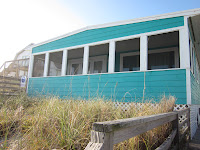
The porch overlooking the Atlantic
     The nearest telephone was a quarter mile down the road, at the little bar and grill at the beginning of the town pier. Between us and town stood four or five other bungalows, plus a small motel with room for a dozen cars to park out front. On the other side of our cottage was an acre of empty grass-covered sand, then a three-story cement structure -- an old, ugly gray military installation left over from World War II, where they used to watch out for German submarines.

     We'd rented the place for a week. We spent five days lying on the sand by day, sitting on the screened-in porch by night. There was no connection to the outside world. For dinner we'd walk down to the pier and eat fried fish, Southern style, and on the way home in the dark we'd see the crabs scurrying across the moonlit sand.

     Every day, the surf rose a little higher. We heard that a hurricane was coming. Local authorities advised tourists to evacuate, but we thought it would be fun to ride out the storm at the house.

     I loved wading into the ocean, then catching the waves and body surfing to shore. But I remember on the fifth day the waves broke with a force that scared me. We talked to some locals. What did they think about evacuating? Well, you never know, we were told, it could get bad.

     We finally decided to leave, a day early, to make the long drive home. We later heard that the hurricane did skirt the barrier island, but caused minimal damage.

     Two years later, we were back at the cottage. This time we made it a family vacation. First, my wife's brother came over from Atlanta for a few days. After he left, my sister came up from Florida. And by that time my wife and I had a young daughter, so we were loaded up with toys and buckets and shovels, along with extra sunscreen and hats and all the paraphernalia that young families bring to the beach. I still remember taking my daughter by the hand and walking along the beach; wading into the water; building enormous sand castles; burying one another in the sand.

     We went one more time, but could only go during a week when the cottage was booked up. But by this time, now the late '80s, a condominium had sprouted up at the end of the island. So we booked into the condo, where we had a pool and two bathrooms and other comforts that a family -- now four of us -- would appreciate. But the condo was back  from the water, with no salt spray limning the screens, no sound of the surf lulling us to sleep at night.

     After that trip, the kids were growing up and other activities took precedence, and we never went back. We took vacations closer to home because the kids didn't like the long drives; and then the kids started going to camp.

The ocean cottage used to be yellow
     Now my two kids are well into their 20s. My wife and I got divorced. We moved out of our old house. We've all moved on with our lives. But as I headed toward Wilmington last week, I could not resist the pull. Perhaps like the tide. The little island was only, maybe, 30 miles out of my way. I had to go see.

      Would the place be the same? Or was it all developed by now? I found the main road on the other side of Wilmington. As I approached the turn-off, I saw a big high school back off the road. That wasn't there before, was it? As I turned onto the beach road, leading out to the barrier island, I saw a shopping center, complete with a Lowe's big-box store. Then I came to the bridge over the Intracoastal, and that looked the same. As I drove down off the bridge and rolled into town, I saw the pier straight in front of me, with the same old bar and grill.

     But what was that wall of buildings, just to the north? I saw a lineup of half a dozen four-story condominiums blocking a view of the water. I turned down the beach road, and saw new homes built on stilts, one right next to the other. I drove to the end of the road, about a mile, and could not find our cottage. I turned around, and spied an old man tending a little park on a corner. I stopped and asked him if he'd lived here a while.

     Yes, he assured me, he had.
The submarine tower, now with decks

     I asked him if he knew about the old cement submarine tower. Was it still here? I couldn't find it.

     He explained that the tower had been bought up by someone who built a new house around it, incorporating the tower into the house. It was just down the block, he said, pointing somewhere along the solid line of beachfront homes.

     I slowly drove along the beach road, down and back, until I spotted it. Yes, I could see the cement tower joined to the wooden house. Nearby were a few older homes, low and squat next to the new and much bigger beachfront homes.

     And then, there it was, looking a little run down, with paint peeling off the porch. I had no idea if my friend's family still owned it. I'd lost touch with my friend after she retired in 1996. That was 15 years ago. She might even be dead by now, I didn't know.

     But there was her cottage, bringing back those memories of a time gone by, when the beach was a lonely solitary place, cut off form the rest of the world, and I was young and and newly married with little kids, and I thought I had all the time in the world.