"I can't be a pessimist, because I'm alive. To be a pessimist means that you have agreed that human life is an academic matter." -- James Baldwin
Showing posts with label Boomernomics. Show all posts

Saturday, March 18, 2023

Whip Inflation Now

     Remember that old line from President Ford? Actually, I think it was subject to a lot of ridicule, because it seemed so ineffective at the time. And of course it is ineffective as a national policy. But there are some practical ideas -- as well as a particular frame of mind -- that can help us save some money and deal with inflation that's currently running at about 6 percent or so.

     For example, Billionaire Warren Buffett knows a thing or two about saving (as well as earning) money. He famously lives in the house he bought for $31,500 in 1958, now worth about $700,000. He equally famously relied on a $20 flip phone for years before he finally gave in and bought an Apple phone in 2020 -- coincidently at about the same time he also bought a chunk of Apple stock.

     Says Buffett: "I do not save what is left after spending. I spend what's left after saving." He also said, "If you buy things you don't need, you will soon sell things you do need."

The Library: It's not just books
     Of course, that's Buffett, who has a way with money that the rest of us don't have. But I saw a good suggestion from a more normal woman on the internet:  Use your library, she says.

     Ask for a tour of your local library and use everything they have to offer. Free books and DVDs. Free access to a computer. Many libraries also offer free classes, book clubs, movie discussion groups, day trips to local museums and concerts.

     A neighbor of mine has been after me now for a couple of years about changing over to a Medical Advantage plan, instead of traditional Medicare plus supplemental plan. He gets prescription coverage as well as dental and vision coverage . . . all for a lower price. The one caveat is that he has to stay within his medical network, but that doesn't seem to bother him at all. Plus, he gets free admission to a local gym -- and he's over there twice a week for a yoga class.

     It's not for everybody, he says. But it's worth thinking about for the next Medicare open enrollment period in the fall.

     Speaking of medical expenses, a friend of ours recently had his knee replaced, and he told us about a medical library run by our Parks & Recreation department. The town loans out all kinds of medical equipment like wheelchairs, walkers, crutches, etc., to town residents for free. If you're going to need some equipment, it might be worth checking out if your town has a similar program.

     I know many people who have "cut the cord" and dispensed with their cable plan, in favor of streaming Netflix and Amazon. It seems like a smart thing to do if you're not the kind of fan that watches live sports on network TV. But even that is changing as some streaming services are starting to carry live sports.

     Others have switched to cheaper cellphone service. We have Verizon. It's a good service, no problems. But it is expensive. So we're beginning to explore some alternatives offered through AARP. There's another service called Cricket. Don't know much about it; but I've got it on my list of services to check out.

      Shop at thrift stores. My brother-in-law reports that he finds lots of gently used name-brand clothes at Goodwill, the Salvation Army and GreenDrop. It takes a bit of picking through the racks, he admits, but he finds some good stuff that looks brand new once he gets it home and puts it through the laundry.

     I'm sure you might have some other ideas. But they all seem to come down to one basic philosophy, as Will Rogers once said: "Too many people spend money they haven't earned, to buy things they don't want, to impress people that they don't like."

     One last tip, since it's getting to be tax time, and you might be puzzled and frustrated with all the different forms and schedules. Various organizations have volunteers who will do your taxes for free, if you make less than a certain amount of money. In my area it's the Bucks County Opportunity Council. In your area . . . well, check at the library, they probably know where to go.

     Meantime, just a word of sympathy from the smartest person in history. It was Albert Einstein who said, "The hardest thing in the world to understand is the income tax."

Saturday, November 19, 2022

I'm Giving Away My Fortune!

     I just found out that I have some surprisingly valuable art hanging on the walls of my house. I am also in possession of a remarkably prized collection of rare, antique shoes. But more on those in a minute.

     I live a modest lifestyle, but you should know that many of America's wealthiest people live fairly modest lifestyles as well. Investor Warren Buffett famously lives in a house in Omaha, NE, that he bought in 1958 for $31,500. Now it's worth a little over $1 million, but that's pocket change for someone worth more than $100 billion.

     I paid much more than $31,000 for my house. So I must be even wealthier than Warren Buffett, right? The fact that I drive an eight-year-old Subaru shouldn't fool you into thinking that I can't make a substantial charitable donation. And so today I am making a major announcement.

     I was inspired to make my pledge by the news last week that Jeff Bezos announced plans to give away most of his $124 billion fortune -- all except a few billion or so. So now, like Bezos, I am "establishing a framework to determine how to donate my wealth."

     Warren Buffett has founded an organization called The Giving Pledge. This is a campaign to encourage wealthy people to contribute a majority of their money to philanthropic causes. Bill Gates has signed onto this pledge. So have Mark Zuckerberg, Elon Musk, Carl Icahn and others. If they follow through, they will each be left with less than $50 billion. And some of the lesser lights, who aren't even worth $10 billion, may have to scrape by with only $1 billion or so!

     So I am now personally and publicly making the promise:  like Jeff Bezos and the others, before I die I will donate every single cent that I own above the level of $1 billion.

One of our priceless paintings
     Of course, I did not found a major internet company. So my fortune is a little less than $124 billion. Also, part of the Bezos fortune is supported by armies of Amazon workers, making $15 to $18 an hour, who contribute mightily to the Bezos bank account. I do not employ any minimum-wage workers who can fatten up my fortune.

     Also, I can't bolster my personal Fort Knox by firing thousands of employees in the name of "rightsizing," the way Zuckerberg and Musk are doing. And unlike some billionaires, I actually do pay my taxes. Every month the government grabs 10% tax, as well as the charge for Medicare, even before my Social Security benefit lands in the bank account.

     However, I do save a lot of money compared to Jeff Bezos and the others. For example, however Bezos avoids income tax, he does have to pay real-estate tax, property insurance and general upkeep on his 27,000-square-foot home in Washington, DC, as well as his 15-bedroom apartment in New York City and his $165 million mansion in L.A. 

     Meanwhile, I just pay for a Buffett-level home on a standard suburban street. Also, think how much I save by not own my own private jet. And just this past summer I saved $28 million by not buying a ticket for a 15-minute Bezos Blue Origin trip into space.

     Already I'm saving $100 million, making me $100 million richer than I otherwise would be.

     Also, I did inherit a substantial amount of money. When I was a kid my Aunt Alice gave me $2 for my birthday . . . every year! The dollars were slipped into an envelope, and when I saw George Washington's face peering out at me through the little hole, I felt like a million dollars . . . back when a million dollars meant something. If I had only held onto that money and invested it in Amazon stock when it went public in 1997, or Apple when it . . . no, no, we won't go there.

At $218,000 per pair they add up
     I am not at liberty to reveal how large my fortune is. However, just last week I not only started "establishing a framework to determine how to donate my wealth," but I began executing the plan. I sent one check to our local food bank for $25, and another for the school clothing drive. 

     Maybe that doesn't sound like much. But, for me, it takes a bite out of my account. And there's more to come, since it's just the start of the giving season. Meanwhile, I wonder what causes you support.

     But back to that art. Just last week a Cezanne was auctioned for $138 million. A Seurat went for $149 million. Look at that painting. I've got lots just like it. Just think how much I'll get for my collection!

     Also last week, one pair of Steve Jobs' Birkenstock sandals sold for $218,000. Well, B has a closet full of old shoes . . . not to mention the boots and sneakers in the back of the garage. What'd'ya think we'll get for them? The Giving Pledge . . . get ready. It's all going to charity. Thank you very much!

Friday, September 16, 2022

The Things They Don't Want

      I have a beautiful old clock sitting in the garage. I bought it for $200 back in 1973. Last time I had it fixed, a few years ago, the guy told me, "This is a museum piece!" He said it was worth thousands. But my wife won't even let it in the house. And leave it to my kids? Hah. There's a joke. They think it's an old piece of junk.

     My wife has an old icebox. It's a beautiful piece of furniture, made of oak, and it weighs a ton. Somebody ought to prize this piece of furniture, too. But no one does, except us. 

My antique clock
      We have a friend who recently downsized from their huge old farmhouse into an 1800-square-foot, one-story house. Their old barn -- now owned by their son -- is full of their discarded furniture. The son doesn't want any of it. He wants the barn cleared out so he can use the space for his equipment. None of their other kids wants it either. So they are agonizing over what to do with the stuff. Sell it? Give it away? A lot of it will undoubtedly end up in the junk yard.

     It's a shame, but there's a lot of stuff our kids don't want.

     And it's not just our old furniture. There was a news item last week in our local paper. Marvin Frederick, 81, has spent a lifetime running his butcher shop in a local farmers market. He wants to retire. He has two grown sons, but neither one wants to take over the shop. And the man can't sell the shop either. He's asking $850,000 for the business, which includes all equipment, recipes, his customer list -- and he's willing to provide one month free training. But so far, no takers. "It's hard work," he admits. "You've got to be someone who isn't afraid to work."

     The kids don't want your business, they don't want your precious antiques, they probably don't even want your property. The house -- especially if it's a second home -- can cause all kinds of headaches, especially if there are a lot of expenses and maintenance issues involved. Arguments and hurt feelings could cause serious divisions if the property is being split among several family members. Time-shares just compound the problem since getting out of a time-share can be difficult and time consuming.

     The only lesson to be learned, I think, is that we should use our things, and not worry about "saving them for the kids." So don't worry if a piece of precious furniture gets scratched, or if you break a cup or saucer and no longer have a full set of dishes. You're enjoying these things, appreciating them for what they are and what pleasure they bring to your life. Then, if the kids don't want those things, at least you've enjoyed them -- which is the reason you acquired them in the first place.

     Leaving our children an inheritance can be a blessing -- something they will continue to cherish in the future as we have in the past. But that's only if they truly want it. Do we really think our kids want our old boat, or an antique car, or the china set we inherited from Aunt Alice? And for goodness sake, do not leave them a storage unit full of old furniture, clothes and sports equipment. 

My coin collection
     Our kids will surely not object to inheriting money. But even an IRA or 401K can cause difficulties. These assets aren't necessarily easy to transfer. The rules are complicated, and there may be emotional issues involved. If it's a substantial amount of money, it's worth the effort; but otherwise it may cause nothing but trouble.

     The best thing to leave our heirs is cash, or financial assets that are as close to cash as possible -- publicly traded stocks or bonds, CDs or bank accounts. Or, go ahead and make an exception for the storage locker . . . but only if that old piece of furniture is stuffed with hundred-dollar bills.

     So, I don't know. Do you think my kids will want my old coin collection that's been shoved into the closet in the guest room? After all, it is cash!

Saturday, August 13, 2022

Will My RMD Save Me?

     Last week I took the annual RMD from my IRA account. Probably most people schedule monthly withdrawals from their IRA or 401K, but for various reasons -- including the fact that Social Security sends me money every month -- I choose a lump sum.

     In completing this exercise I found out a few things. Some good, some bad.

     The good news is that according to the Federal government my life expectancy has somehow gone up -- and yours probably has too. Last year my life expectancy was 24.7 years. Now, even though I'm a year older, the government says my life expectancy has increased to 25.5 years. Don't ask me why. But you can't argue with the government.

     The other good news is that my RMD -- by the way, that's Required Minimum Distribution, the amount of money we withdraw from our IRA or 401K per year -- is $953 more than last year. That's thanks to a booming stock market in 2021. So I'm getting a raise!

     However, the balance in my IRA plan has gone down by about 5% since the beginning of the year. So unless the stock market gets better soon, next year's RMD will be less than what I'm taking this year -- and again, the same probably goes for you too. So we'll all be living longer, but getting less money.

     More bad news. Well, it's not news. I've known it all along. I do not have a pension. (I admit it, I am jealous of those of you who have a pension.) The pension I was supposed to get was rolled over by my company in the 1990s into what they call a cash balance plan, which eventually became my IRA. So in effect, what I have is an IRA instead of a pension. 

     In other words, I'm on my own. Which is okay as long as the stock market goes up. Yes, the majority of my IRA is in stocks (well, in stock mutual funds). And yes, that might be considered a little risky. But there's no way a bond fund or a money market fund will keep up with inflation.

     But that's okay, because of Social Security. I don't have to worry about the value of Social Security going down like my IRA has. In fact, Social Security is tied to inflation. So I got a 5.9% raise for 2022. We all did. And for next year they're talking about an increase of up to 9% (although it'll almost surely be less than that).

     So I'm okay. Maybe not quite keeping up with inflation, but close to it.

     But here's the thing. The government says I'll live another 25 years, bringing me up to 2047. But the government also tells us that unless things change, Social Security will run out of money in 2035. The proverbial lock box will be empty. And that means benefits will have to be paid out of then-current payroll taxes, which in turn means Social Security will only be able to pay out about 80% of earned benefits. Goodbye raise, hello decrease.

     So if we go by the government, after 2035 I'll still be alive, but old and poor. Will my RMD save me? Who knows. But still, that's 13 years from now. What me worry?

Saturday, July 30, 2022

Keeping Up with the ... Kardashians?

      We used to keep up with the Joneses. Oh, we said we didn't. But when we saw a new Mustang in our neighbor's driveway, we started thinking, maybe we could get one too. Or our friends were talking about their trip to Europe, and suddenly we wondered if we owed it to ourselves to make the trip. After all, it wasn't just a vacation, it was a learning experience!

     But nobody keeps up with the Joneses anymore. Now there's Facebook, Instagram, Tik Tok and all the other social media. So today people keep up with the Kardashians.

     The result is just the same, or worse. We go into debt, we don't appreciate our purchases, we feel guilty . . . we feel worse for the experience. Or, if we can't afford to do what they're doing, we're jealous, or we resent it.

     Come on. Be honest. Haven't you ever seen a friend's post on Facebook or Instagram and they're sipping a drink on some tropical beach with a fancy hotel in the background? And you thought to yourself: Gee, if she can spend a week in Belize, why can't I?

Good times
     If that's not true, then why do we scroll through social media and see so many of our friends on vacation basking on the beach or sipping exotic cocktails? Why do we see so many people riding on the lake in their new boat? Or there's a picture of their new deck and backyard. Or they're going to a concert, attending a football game, riding their new electric bike.

     There's even a name for it:  revenge tourism, or revenge spending. The term captures the notion that we were deprived by Covid for a year or two, so dammit, we're going to make up for lost time right now, no matter the cost, no matter how it stretches our credit card bill or depletes our IRA account. Who knows what crisis lies beyond the next bend? We'd better grab our experience now while we can. As the saying goes, you only live once . . . or YOLO.

     Everything's gotten more expensive. But we're willing to do it anyway. And we seniors have yet another excuse. We're not getting any younger. Maybe we won't be healthy enough to travel in a few years. So we better do it -- and do it now!

     As for me, I drove through town the other day and noticed that every restaurant was full, people sitting at outdoor tables under the umbrellas. People were waiting for tables, spilling out onto the sidewalk. They all looked like they were having so much fun. I wanted to go out to dinner too!

     So perhaps we're not keeping up with the Joneses, or even the Kardashians. We're keeping up with our friends and acquaintances and people we hardly know.

     Meanwhile, my brother-in-law just posted on Facebook a photo of himself in Paris. A friend posted a picture of her new patio furniture on Instagram. Are they posting because they want me to share their enjoyment of that experience . . . or because they want me to be impressed? As much as I try to resist it, I'm feeling the fear of missing out, or FOMO. It looks to me like I'm sitting at home in front of my computer while they're active and alive and enjoying life to the fullest.

     Social media provides us with a lot of free entertainment. But I wonder if in the end it's costing us a lot.

Saturday, May 14, 2022

It Costs How Much?!?

     We toyed with the idea of taking a special vacation this summer. Back in March my daughter in Wisconsin talked about traveling to Italy and wondered if we'd like to join them for a few days.

     A vacation in Italy? Sounded pretty cool. I checked American Airlines. A round-trip ticket was $985. Expensive, but doable.

     We didn't hear any more about the trip from my daughter, so we didn't do anything about it. Then last week, she brought it up again. I went back to American Airlines. Oops . . . now the round-trip fare is $1,359! It's gone up by over $300 per person. And if the airfare has gone up, so too have the hotels, restaurants and anything else we'd want to do.

     So we're not going to Italy this summer.

    We paid $504 to fly to Wisconsin in March. Now I was curious. So I checked. The price is now $622. I'm not sure if we'll be going to Wisconsin this summer either. (And with gas at $4.59 driving isn't any better.)

     It's not like we canceled our trip to Italy. We hadn't actually made the plans. It's just that we decided not to do it.

     I wonder what you're deciding not to do because prices have gone up.

     We are trying to save in other ways as well. We already cut back to one car last summer. And boy, it definitely helps the budget not to have to come up with that second car payment . . . plus insurance, registration, upkeep. And besides, with gas prices the way they are, we've actually been driving less.

     I don't think it's been a conscious decision. But instinctively, we've been walking more, batching trips, going to our local supermarket rather than making the drive over to Costco. I bought a garden rake and bag of grass seed at our local hardware store, because I didn't think it was worth driving down to Home Depot. I'd save a couple of bucks at Home Depot; but spend the savings on gasoline.

     We haven't let go any of our newspaper or magazine subscriptions. But we were remarking just the other day:  the Sunday NY Times now costs $6.00. For one lousy newspaper! We'll be looking at those subscriptions as they come up for renewal. Do we actually read them? Do we really value what they have to say?

     We will not cancel Netflix or Amazon. We watch a fair amount of TV on those two services. (I'm watching the latest season of Better Call Saul; B is watching Old Enough; and together we're watching Friday Night Lights.) 

     But ordinarily, we might be signing up for HBO Max or possibly Hulu. Not now. Netflix and Amazon have both raised their prices, and we surely don't need another streaming bill layered on top of everything else.

     I read recently that overall prices have gone up 8.3% since this time last year. The "typical" American family is spending $340 more per month just to keep up with the basics.

     The cost of food is up 9.4%. We're still eating pretty well. That's important to us, and so we pay the price. But we got out of the restaurant habit when Covid arrived two years ago. Lately, we've been thinking of going back now that the weather is warmer and we can eat outside. The other day we talked about going downtown to one of the outdoor venues. But then we thought -- nah, let's just do takeout. So we didn't drop $50 or $60 on a restaurant meal, we instead spent $18 for takeout from our local chicken place. 

     So to deal with inflation, we're cutting back on travel, driving, restaurants, streaming services. Are you doing anything to economize these days?

     A lot of us are on fixed incomes, so maybe you always have an eye toward economizing. Some people make a game of it -- whether it's clipping coupons, scouring Amazon or shopping the flea markets and seasonal sales. Others consciously limit their purchases to try to save the earth. If you don't eat meat, it not only saves money, it saves the planet.

     But for us these days, it's the prices that are setting the rules of the game.

Sunday, January 2, 2022

Blame the Upper Middle Class

     I usually don't talk about the books I read, mostly because they're not worth talking about -- mysteries and thrillers by Michael Connelly, Robert Crais, Tana French, Louise Penny. I just started Y Is for Yesterday, the last book by Sue Grafton.

     But I recently read two interesting nonfiction books mentioned in the NY Times book review. They both basically blame all the economic ills of our country not on the super-rich, but on the upper middle class. Not the top 1%, but the other top 9% -- the doctors, lawyers, professors, accountants and faceless administrators and bureaucrats who run our government-regulated capitalistic society.

     These are the people who believe in our merit-based economic system. They credit their success to talent, education and hard work. But according to these authors, this professional class consists for the most part of people (as was said of George Bush) who were born on third base and think they hit a triple.

     There's just enough truth to their view that it makes sense . . . to them. It does take a good education and marketable skills to get ahead in our world. But much of their success has less to do with hard work, and more to do with winning the lottery of birth. Most are born to rich, educated parents. They benefit from an enriched childhood, good suburban public schools (or private schools), a ticket to a good college, and maybe even a leg up to find that cushy well-paying job. 

     Just one example. A prized experience many job interviewers look for these days is an internship. It shows interest, dedication, knowledge. Many internships are unpaid. Who can afford to spend months working an unpaid internship? The children of the upper middle class. And how do you get one of those prized internships? Sure, some are broadcast to the public and can be applied for on an even basis. But many are posted on the bulletin boards of those exclusive colleges, or heard about from a vice president who lives in the McMansion down the street.

     Just so you know, the median individual income in the U. S. today is about $44,000 per year. (It depends where you live. The average is about $35,000 in Mississippi or New Mexico, but $55,000 in Maryland or Massachusetts.) To be in the top 10% of earners, you need to make about $110,000 a year as an individual, or over $200,000 in household income. (If you live in Maryland or Massachusetts you need more than $280,000 to reach the top 10%!)

     Why so much more as a household? Blame it on what the authors call "assortive mating." College graduates tend to marry other college graduates, and since college graduates make more money than those who don't go to college, these households have comparatively more income. When lawyers marry other lawyers, or financial analysts marry other financial analysts, the cycle of inequality just gets worse.

     The authors are careful not to blame people who want to succeed, or parents who want their kids to get ahead. It's only natural. But as a class, that top 9% -- the upper middle class -- gets the lion's share of economic benefits, and thus perpetuates inequality. They're the ones who can afford to reap the tax benefits of IRAs and 401Ks, for example, while people on the bottom rungs of the economic ladder can't afford to take advantage of these retirement vehicles.

     It's the upper middle class that rushes to open tax-advantaged 529 plans to fund their offsprings' college education -- making sure their children and grandchildren go to college and perhaps graduate school, to perpetuate their prized economic status into the next generation and beyond.

     It's also the upper middle class that reaps the most rewards of home ownership. They get a tax deduction for mortgage and real-estate tax -- the more expensive the house, the more rewards they reap. And the expensive house gains them entry into a good local school system, easing the way for the kids to attend a private college or top state university.

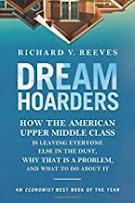
     There's a lot more to the story of how the upper middle class maintains its favored status, and why that's a problem for the rest of the country. If you want to know more, the first book is: Dream Hoarders: How the American Upper Middle Class Is Leaving Everyone Else in the Dust by Richard Reeves.

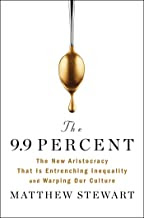
     The second one is: The 9.9 Percent: The New Aristocracy That Is Entrenching Inequality by Matthew Stewart.

     I like the Reeves book better. It's shorter, more to the point, and seems more factual. I recommend it to anyone who's a member of the 9.9%, who resents the 9.9%, or who cares about how our economic society really works. To me, the Stewart book seems like more of a political rant. Besides, you can access his 2018 article in The Atlantic which will give you the bones of the book in a tenth of the time.

     What . . . you thought when 2022 arrived there'd be no more homework?!?

Saturday, October 16, 2021

What Would You Do if You Were Rich?

     What would you do if suddenly you came into a lot of money -- like ten times the amount you now have? We asked this question at a Socrates Cafe session we attended (on Zoom of course). The question was seen as a way to get to the more fundamental issue: What do we want money for?

     (Socrates Cafe is a discussion group through our local retirement learning center. It's part of a larger movement encouraging people from different backgrounds to exchange views and perspectives based on their own experiences.)

     There were about 16 or 18 people on the call. The first person piped up: "My first reaction:  I would buy a bigger house." Then she paused. "But even as I'm saying it, I realize that might not be the right answer -- not because I want to be politically correct, but because maybe that's not what I really want." She paused, reflecting, "With a bigger house comes more work, more cleaning, more upkeep, more worry." Then she brightened. "Actually, maybe what I'd really want is a second home -- a house on the beach!"


     The second person to offer a response said, "I'd hire myself a personal assistant -- someone to handle all the annoying but necessary chores in my life from paying bills to making appointments, answering emails, cleaning the house, organizing the insurance, the medical bills. I'd really love to be free of all that hassle."

     So . . . what would YOU do with a whole lot of extra money?

     One guy raised his hand. He paused for a moment, then said: "I would do nothing." When met with surprised stares he explained, "I pretty much have everything I want right now. Besides, I'm in my 70s. I'm trying to get rid of stuff in my life, not acquire more things."

     One woman explained that her nephew suffers from learning problems and mental health issues. He graduated from high school, but he has trouble keeping a job and is prone to fits of paranoia. She knows he will never be able to fully take care of himself. If she had the money, she would set up some kind of trust for him, so she could rest assured that he'd never end up living on the street or in some terrible shelter.

     Another fellow is an immigrant from a Caribbean country. He came to America in 1970, got an engineering degree, had a successful career, was able to support his family -- and even send some money back to his immediate relatives. If he had more money, he said, he would set up a foundation to help feed, clothe and educate all the people he left behind.

     Another woman said she was less ambitious than that, admitting she didn't have any special cause she wanted to support. She'd give some of it to charity, of course, but what she really wanted to do was travel more. "If I had plenty of money," she said, "I'd go to Hawaii, I'd go to Asia, I'd take a river cruise in Europe ... and maybe the Galapagos. I'd love to see the Galapagos."

     If you think the idea of suddenly receiving a boatload of money is preposterous . . . not so fast! The government just announced that Social Security payments are going up a bracing 5.9% next year. And a group called The Senior Citizens League is campaigning for special $1,400 payments to Social Security recipients. So if you got a $1,400 bonus -- or presumably $2,800 if you're a couple -- are you traveling to Hawaii or sending it to disadvantaged people in the Caribbean?

Saturday, May 8, 2021

Second Home -- a Good Idea?

      So my wife and I are finally traveling. We're vacationing in South Carolina and visiting children and grandchildren while we're here, as we've done almost every year since the kids moved down from New York in 2012.

     We always get our own place when we come. Their house really isn't big enough to accommodate us. Plus, we'd rather be out at the beach rather than in the suburban development where they live.

Our rental. Would you buy it?
     It only takes a few days for us to become accustomed to the Carolina beach lifestyle, which at this time of year involves throwing open the windows to the sea breezes, wearing t-shirts, and going out to the beach or up to the marina to watch the sunset.

     And it only takes a few more days before we start looking around and begin thinking about buying a second home at the beach -- or near the beach. Lots of other people do it. Why can't we?

     Just last night we ate outside at the Salty Dog Cafe. We were outdoors so we didn't have to wear masks. There was a nice breeze wafting off the water so we didn't even have to worry about Covid. After dinner we walked up along the boardwalk, got ice cream, then stuck around to watch the sun set over the sailboats. We strolled down the boardwalk, eyeing the condominiums that face the water and the sinking sun beyond. 

     This morning I recalled reading an article about owning a vacation home by Jeremy Kisner, director of financial planning at Surevest Private Wealth in Phoenix, AZ, who writes a blog Clear and Concise Financial Advice. I thought I'd better consult the piece to get a dose of reality. Is it really a good idea?

     Here's what Kisner says about second homes:

     I thought vacation homes sales would be breaking records since Baby Boomers are better positioned to buy them than any previous generation. A number of other factors should also be propping up the vacation home market: a strong economy, a decade-long bull market in stocks, low mortgage rates.

    However, vacation-home sales, despite having picked up within the last year due to the crosscurrents of Covid, have actually been relatively weak for the past decade. For example, price appreciation in popular vacation home areas lagged non-vacation home areas by some 10 percentage points from 2015 through 2018.

     One reason vacation home sales have lagged may be airbnb and other similar sites. These services have made it easy to find vacation rentals in desirable places -- without any down payment, mortgage or upkeep costs.

Jeremy Kisner
     Are you still tempted to buy a beach house, mountain cabin, or Gulf-side condo? If so . . .

Here are a few things to consider before buying a vacation home:

     Costs. The median vacation home price nationwide is over $200,000 -- higher in popular beach locations. In Delray Beach, FL, for example, the median house price is over $300,000. Even if that seems reasonable to you, do not underestimate the ongoing expenses. A modest home will likely have up to $1000 in monthly expenses (taxes, utilities, HOA, maintenance).

     Financing. Approximately 30% of second-home buyers pay all cash. The remaining buyers need to come up with a hefty down payment. Most banks require 25 to 30% down on a vacation or rental property. They also require a higher credit score and charge higher interest rates. This is because these properties have more severe default rates than primary residences.

     Insurance. Homeowner insurance tends to be more expensive for vacation homes than for primary residences, because vacation homes are at greater risk for damage or theft since they are not lived in year-round. You may be required to carry a "landlord policy" which can cost 20 or 30% more than typical homeowners insurance. In addition, many homes are in hurricane or flood zones. Due to more severe storms, flood insurance costs have gone up significantly in recent years.

     Renting it out. People who rent out their vacation homes do so for an average of 18 weeks per year, according to HomeAway, a vacation rental marketplace. Property management firms typically get 20 to 35% of the rental income. Or you can do the work yourself. Some people make a decent side income by renting out their guest house on airbnb or VRBO. However, it usually takes a few hours a week to respond to inquiries and coordinate check-ins, check-outs, reviews and cleaning services. For more information about potential rental income vs. expenses consult this rental income resource.

     Classification as a Rental Property. If you limit your personal use of your second home to 14 days, or 10% of the time it's rented, it can be classified as a rental (investment) property. That means you can write off most of the expenses (insurance, maintenance, utilities, interest, depreciation) against the rental income. If the result is a loss, it is typically considered a Passive Activity Loss which in most cases can be used to offset other income on your tax return. 

     Classification as a Vacation Home. On the flip side, your property will be categorized as a vacation home if it is used primarily for personal use. You do not get to write off all the expenses like you do with a rental, but you can still write off the interest expense as an itemized deduction assuming you meet the requirements. In addition, you can rent your place for 14 days or less and keep that rental income tax-free, with no extra reporting requirements.

     Second homes can be a great place to make memories with your kids and grandchildren. They can also be a major expense and/or commitment of time. So a piece of advice: the wealth-maximizing strategy for a second home is to have a friend or relative with a vacation home ... and then an offer to house sit.

Wednesday, February 24, 2021

Remember Inflation?

     B came home the other day and said to me, "Gas prices are way up again. I paid over $3 a gallon!"

     We've gotten used to a low gasoline prices for the past year, ever since they plummeted due to the pandemic. But I checked. B is right. Gas prices have gone up -- by 15% in the last month alone. And today they are 3% higher than this time last year.

     Then we got a notice from our town. We were told that due to Covid, which has caused town expenses to go up and revenues to go down, our town taxes are increasing 12% this year. 

     The school tax has edged up just 2%. But that's still higher than the general inflation rate of 1.4% as reported by the federal Bureau of Labor Statistics. And with all the pressures that schools are under, I wouldn't be surprised if 2021 brings a much larger increase.

     Fortunately, our Social Security benefit is adjusted for inflation, at least by some measures. We got a 1.3% increase for 2021. But some of that extra money got stripped away by a 2.7% increase in Medicare premiums.

     Food prices are up. I read that chicken prices are 20% higher than last year. Meanwhile, the price of plastic is 8% higher, raising the cost of virtually every packaged good we buy.

     And I hope you don't want to buy a house. According to the most recent Case-Shiller report the price of the average home in the U. S. is up by 10.4%  from Dec. 2019 to Dec. 2020.

     Inflation has been low for a number of years. It is possible we've been lulled into a false sense of complacency?

     Inflation can have a big impact on retirees, since many of us live on fixed incomes. And even though we no longer have to feed a family or save for a child's high-priced college education, we still have to cover food, housing and medical bills. As an example, if the inflation rate goes to 3% and stays there, our costs will go up by 16% over five years and 34.5% over ten. So ten years from now that $3 gallon of gas will set us back a little over $4, and everything else we buy will cost a third more.

     Of course, you might think . . . ten years from now, who cares? But assuming Covid doesn't kill us, a lot of us will be around not just for another ten years, but for 15 or 20. Today, the average 70-year-old  lives to age 85 -- and one in five of us will live past age 90. So we need to consider our financial lives well into the future.

     For example, you might want to check your pension. Many pensions are not adjusted for inflation, but some are. If you have a pension, it would be good to know if your payment is tied to inflation, so you can modify the rest of your life accordingly.

    You might also want to bring up the issue with your financial adviser, if you have one. In the meantime, you should know that if you have an annuity, or invest in bonds, the higher the inflation rate the more you lose out. On the other hand, stocks (or ETFs or mutual funds) in your 401K or IRA will generally go up along with inflation -- unless we hit a period of hyperinflation like we did in the 1970s. Commodities like gold -- and yes, evil oil -- tend to outperform during inflationary times. Maybe bitcoin, too. I don't know. I wouldn't know what to do with a bitcoin.

     Real estate rises along with inflation, so owning your own home is a good hedge against inflation. (See the 10.4% increase in home values cited above.) Rental property also pays off during inflationary periods since you can usually raise the rent. But remember, when you're a landlord you're not truly retired. Managing real estate takes time and attention, and not everyone thinks it's worth the trouble.

      You can always fight inflation by downsizing. You can sell off a second car, or move to a community with a lower cost of living. Or you can decide not to travel. We're now looking at a rental place for next winter in South Carolina -- the same place we've rented twice before. The quoted price is $1,500 a week -- which is 5% more than last year's price (when we didn't go) and 12% (gulp!) higher than what we paid when we were there in 2019.

     Or you could always get a job. Unlike pensions, wages and salaries often increase with inflation and so employees are carried along on the inflation ride. But I don't know about you. I'm retired. I don't want to have to go back to work just to buy chicken or pay the town tax.

     However, we'll have to see about that vacation. I'd hate not to be able to go on vacation.

Saturday, February 6, 2021

"I'm Mad as Hell. . ."

      I'm an optimist. I usually focus on all the progress the world has made during our lifetime. The end of the Cold War. The spread of literacy. The decrease in poverty. The decrease in racial and sexual discrimination. The increase in life expectancy. Advancements in science and medicine.

     But sometimes, just sometimes, you see the other side of the coin.

     The other day I ran across a post on Reddit, a social media outlet targeted toward Millennials, in connection with a spike in certain stocks on Wall Street. I don't know if you paid attention -- but smaller companies like Gamestop were bid up by a group of individuals from social media, and the phenomenon was billed as a kind of revolt against Wall Street. The situation quickly passed. It was just a media-hyped fad. But I think a significant Millennial sentiment was captured by an ER doctor who wrote an open letter to Wall Street:

     When I was a resident physician in Detroit, Obama was president. During his presidency the quality of life of the predominantly African Americans in Detroit did not improve. Despite Obamacare, I saw little improvement in the health outcomes of the patients I worked with. I saw continued proliferation of illicit drugs, overdoses, and gang violence. YOU have left these people behind.

     I spent the last several years working in a small town in the Midwest, when Trump was president. During his presidency the quality of life of the predominantly white Americans also did not improve, and have in fact worsened. I saw continued proliferation of illicit drugs, overdoses, and suicides. These patients I care for are also people YOU have left behind.

     With the pandemic I have seen those who are already at the brink of financial solvency lose their jobs and I see lines outside food banks. I see the health outcomes of my patients decline as they forego preventive care. I, on the other hand, kept my job, got a raise, and saw the value of my 401K rise as the economy crashed around me. Going to work every day is a constant and stark reminder of the brokenness and disparity of the economic system and my sheer powerlessness to change it. I realize now that it is not political. It is YOU.

     This brought home to me the reality that I have not suffered at all financially from the pandemic. My Social Security deposit arrives on time. My IRA balance has only gone up. And since I'm spending less, I actually have more money in the bank -- even though my wife and I sent extra contributions to various charities during December.

     The pandemic has impacted our children to some extent. But not that bad. One actually got a new job, with an increase in salary. One is able to work from home, at full salary, and is saving the time and money of commuting. One did get furloughed for several months in the spring. But he's back to normal now.

     Do I feel guilty that the pandemic hasn't impacted me as negatively as others -- that my IRA keeps going up as so many other people are suffering? No, I don't. Do I feel lucky? Yes, I do.

     There's a lot of irony is this "revolt." First, it didn't come from the poor and disadvantaged. It came from middle-class people who had the time and money to speculate in the stock market. Also, there was a tinge of nostalgia about the whole thing. The Reddit crowd didn't bid up shares of Apple or Amazon. They plowed into Gamestop, AMC theaters, Blackberry, Nokia and other struggling companies that were popular back in the 1990s. The Millennials must think that things were better back then when they were growing up. But don't we all think that to some extent?

     Was this physician right to blame Wall Street for all these problems? Maybe . . . but Wall Street was just as big and powerful in the '90s as it is now. Is it the political system? Is it big tech? Or should he blame his complacent, self-satisfied Baby Boomer parents?

     Beyond the blame, what can we do that neither Obama nor Trump could do repair our economic system? To help lift the despair felt by so many that leads to taking illicit drugs and committing suicide? To give people more opportunity . . . and perhaps even more importantly to rekindle the feeling that the future is brighter than the past?

Sunday, November 1, 2020

Saving the Planet with Covid

      One silver lining to the Covid-19 pandemic is that air pollution levels have gone down, not just around metropolitan areas but throughout the country -- and even in China!

     Most of us are driving less. I last filled my gas tank over three weeks ago, on October 9, and the tank is still 3/4 full. Instead of grumbling about the cost of gas, I'm complaining about the monthly payment for the lease on my car that sits in the garage all week.

     But maybe it's better this way. We live in town. Our street is not a major artery, but it is a through street so we normally get a medium amount of traffic. But lately, we can sit on our front porch and not see a single car go by for ten minutes.

     For the past six months, having two cars has been a hassle, and so we're now starting to think maybe we can get along with just one. My lease runs out next June. My plan right now is to replace the car with a bicycle. A bicycle is not the perfect way to get around. There's traffic to negotiate, and it's no good in the rain or the winter. But it might be worth a try.

     If that doesn't work, maybe we'll get an electric car. But I'm not quite sold on the idea. I've read that an electric car, after you account for making and disposing of the batteries and generating the electricity, saves only about 20% of the pollution. Now 20% is better than nothing. But you can do just as well simply by trading in a 22 mpg SUV for a 27 mpg car. 

     Covid is definitely changing our thinking and our habits. Is the pandemic changing yours?

No more of this
     We've been recycling paper and plastic for years now. The only problem is, I've read that they can't recycle all the plastic. It's just too much. A lot of it ends up in a landfill anyway. So we're trying to cut back on plastic. I used to drink bottled water. Now I fill my glass at the tap. Our town water is perfectly fine. 

     We've tried all along to bring our own tote bags to the grocery store -- but somehow we hardly ever remembered. So we went through a lot of plastic bags. But now with Covid, we wouldn't be caught dead taking a plastic bag from the supermarket. We've completely changed that habit. We never go anywhere without our tote bags.

     It almost goes without saying that we're traveling less. Covid has been killing the airline industry. But it's saved a whole lot of jet fuel. Maybe after this is all over, the airlines will be downsized, and we can spend less time flying in jet planes. Sure, you might want to take that special trip to Hawaii or Europe, or to see family. But we won't be quite so casual about contributing to all those jet fumes.

     Instead, we're discovering the charms of the Microadventure  For us it's been an afternoon at a park, a drive to visit another town. But even more adventuresome people are discovering sights closer to home -- Boston or Washington instead of Paris or Helsinki; one of the national parks instead of el Camino de Santiago, a local beach instead of Cancun.

     We don't eat much meat anymore, not because it's environmentally punishing -- although it is -- but because we're trying to be more healthy. We had a steak dinner for B's birthday. And we ate hot dogs exactly one time this summer when we had a cookout. Other than that it's chicken and fish and lots and lots of vegetables. (Not that we're perfect; we do like our baked goods.)

     We do not grow any of our own food. That would be a good thing, but we don't have the property or the green thumb. Instead, we signed up with a local farm to supply fresh produce. It's a little more expansive, but still cheaper than all that meat. And nothing comes wrapped in plastic. 

     We've also been more careful about throwing away food. We have leftovers once or twice a week -- again, not trying to save the environment -- although it does -- but because in these pandemic times we want to cut down on the number of trips to the grocery store.

     Like many other people, we use the library more. We haven't needed much in the way of clothes. We support our local restaurants by doing take-out -- for us, mostly curbside pickup at the pizza place.

     In many ways I can't wait to get back to normal. But maybe, just maybe, a few of these new habits will stick with us -- and we'll take one small step toward saving the planet. 

Sunday, August 30, 2020

The Health and Wealth Gap

     Retirees are not worried about money. We are worried about contracting Covid. Our children are not worried about Covid. They are worried about money.

     So Covid presents a health gap between young and old, as well as a wealth gap between young and old. That's an undeniable conclusion from an Edward Jones and Age Wave multi-generational study of some 9,000 Americans.

     It makes sense when you realize that Covid-19 has in six months killed over three times the number of Americans who died in all the years of the Vietnam War. Today Covid is the third leading cause of death, behind heart disease and cancer, but ahead of Alzheimer's, accidents and any kind of criminal activity including gun violence.

     Most of the people who get Covid are under 40. But most of the people who die from Covid are over 60. A quarter of people over age 60 who come down with Covid end up in the hospital. But only 3% of those under 40 spend any time in the hospital. And they usually get better. It's extremely rare for someone under age 40 to die of Covid.

     But if retirees have to worry about Covid, we are not by and large worried about our income. We're not losing a job or suffering a cutback in pay. Our incomes are secure, from Social Security, pensions, IRAs and other non-earned income. Plus, three-quarters of retirees own their own homes, half of us owning outright with no more mortgage. So only about 10% of retirees report that Covid has "negatively impacted" their financial security.

     For our children it's a different story. They have lost over 20 million jobs. Some of those jobs have come back in the last two months. But further layoffs linger. And nobody knows how many are still working but are taking home half a salary, or even less.

     In our case, out of four children, two are still working at full salary. One was furloughed for three months on a fraction of his salary. He's now back at work, hoping for the best. The fourth kept his full salary until June, then was cut back by 50%, and recently was cut another 15%. He still has a job, but there are no clients and there's not much to do . . . and he's fearing the worst.

     Our own experience reflects the broader picture. According to the survey, a third of Millennials say their finances have been impacted by the pandemic. Many of them have stopped making contributions to their retirement plan, and a significant number have dipped into their retirement account to pay current bills. Some adult children have even been forced to move back to their parents' home due to a job loss.

     The financial stress has also caused mental health issues. Over a third of young adults say they have suffered mental health declines since the pandemic began, compared to just 10% of their parents

     It's another story for younger Baby Boomers who are not yet retired, but suddenly find themselves out of work. Some Baby Boomers Are Pressured to Cut Spending since they're too young for Medicare or Social Security, but they may still have children to support or college tuition to pay -- and yet their prospects for finding a new job are slim to none due to ageism. Even 50-somethings who are up on the latest technologies are often passed over in favor of younger people with fewer skills.

     Meanwhile, almost half of retired Americans said the pandemic has made them worry more about their children. Some 24 million Americans say they have provided some financial support to their adult children during the last six months. Many of us have had no problem helping our kids. Our income has remained steady, but expenses have gone down, so we have more money sloshing around in our accounts -- money we can afford to give away.

     But others have to put off more necessary expenses in order to help their kids -- delaying home repairs, foregoing new clothes, stretching out credit-card payments. Yet the majority of retirees still say they would offer financial support to their kids even if it did jeopardize their own financial future.

     Many of us can afford to help our kids now, but we worry the economic impacts will linger, causing us to compromise our longer-term financial security. The majority of retirees see retirement not just as an end to work, but as a new chapter in our lives, when we can pursue new dreams, enjoy new freedoms, take on new challenges. Covid by itself puts a brake on pursuing new opportunities since it's hard to connect with a new group or a new cause when we can't meet people face-to-face. Any financial squeeze just further inhibits our pursuit of new opportunities.

     There is at least one silver lining to Covid. According to the survey, two-thirds of Americans said the pandemic has brought their families closer together. The experience has inspired them to have important discussions about financial planning, preparing for retirement, end-of-life issues, and strategies for protecting and improving health. Perhaps we could also count our new proficiency in Zoom and FaceTime!

     Also, we retirees have something going for us:  We have seen a lot of problems come and go. We have a longer-term view. We realize that as hard as it is, this too shall pass.

Saturday, July 18, 2020

Is Joe Biden Good for Retirees?

     Presidential candidate Joe Biden recently announced his economic plan for America. Normally, I try to stay away from politics on this blog. But a tax plan is something you can analyze, not just to judge whether you're for it or against it, but in terms of who it would help and who it would hurt.

     By way of full disclosure, I like to think I know what I'm talking about when it comes to these matters (I did get an MBA back in the dark ages), but I am not an expert so I invite anyone to correct or expand on my analysis.

     Here's a rundown of his proposals.

     Income taxes. Biden wants to take back the Trump tax cut. For example, he would increase the top individual tax rate for incomes above $400,000 from the current 37%  to the pre-tax-cut level of 39.6%. This might affect certain individual retirees ... but I doubt those individuals would get much sympathy from the rest of us.

     Payroll taxes. Biden wants to impose a 12.4% payroll tax on wages over $400,000. Currently, only wages up to $137,700 are subject to payroll tax. The new tax would benefit retirees since it would help shore up Social Security. It would benefit retirees even more if Biden didn't create a "donut hole" to exempt wages between $137,700 and $400,000, and just make all wages subject to the payroll tax.

     Capital gains taxes. He proposes raising the capital gains rate up to the same rate as earned income. Many people think this is perfectly fair -- why should investors get a tax break over workers? -- but make no mistake, it would be costly for anyone who has built up investments outside of an IRA or 401k.

     Itemized deductions. Biden would restore a higher limit, up to $400,000, on itemized deductions. This would be a favor for high income people in high-tax states such as New York and California, bringing them a tax cut. But who retires to New York or California? So theoretically it would hurt the rest of us, since we'd have to make up for those lost revenues.

     Corporate income taxes. Biden proposes raising the corporate income tax from 21% to 28%, which is halfway back to the old rate of 35%. Obviously, increasing the corporate rate doesn't affect individuals, except in a very indirect way. Some Wall Streeters warn a corporate tax increase could take down the stock market by 10 - 25%. But that's sheer speculation. If the stock market takes a tumble it's much more likely to be caused by the Covid economy than a corporate tax plan.

     Minimum corporate tax. He would create an alternative minimum tax on corporations with profits of more than $100 million. The idea is that it would tax at least some profits of companies, such as Amazon and Netflix, that have evaded taxes by the clever management of tax laws and business regulations.

     Special interests. Biden would offer tax credits to small businesses for adopting workplace retirement plans. This would not help current retirees, but it would help many future retirees who work for small businesses. He would expand some tax credits for renewable energy and restrict tax credits for fossil fuels. Again, this wouldn't affect current retirees; but it would make one small step toward helping the future of the planet. He's also proposing an $8000 tax credit for child care, eliminating some real-estate tax loopholes, expanding Affordable Care Act tax subsidies.

     Bottom Line. Only you can decide whether Joe Biden will make you richer or poorer, whether his ideas strike you as "more fair" or "more just" than the current system. But I can tell you two things:

     1) The plan is hardly radical. That may disappoint progressives, but reassure moderates. He is not proposing a wealth tax or even an increase in the estate tax. He is not proposing a single-payer medical plan. Instead, he calls for an extension of Medicare and an expansion of Affordable Care Act. He has put forth a more ambitious climate-change plan, but has not said how he would pay for it (so you have to question whether it's real). As a response to the economic upheaval caused by Covid-19 he claims he'll create at least 5 million "good paying" jobs in clean energy, research and development, and minority-owned businesses.

     2) Joe Biden's plan will not make the U. S. tax system any simpler. Unlike Amazon or Netflix, we will not be able to "game" the tax system, yet we will still need an accountant or Turbotax just to fill out all our tax forms. And the lawyers and accountants who feed off the complications of the tax code will not have to worry about any loss of business.

Sunday, January 26, 2020

Things I Just Don't Understand

     We live in confusing times. And I for one am not afraid to admit it.

     It wasn't long ago when we knew how the economy worked. Prosperity was good. Jobs were good. Ambition was good. We saved for the future and aspired to live more affluent lives than our parents did. We agreed on a set of moral and social principles. Politeness was good. Consideration was good. Narcissism was bad. Insults were bad. Crime was bad.

     But everything has become much more muddied in our modern times. For example:

     The Federal Reserve worries about deflation, and for years has been trying to get the inflation rate up to 2%. According to the Bureau of Labor Statistics the 2018 inflation rate was only 1.9%, and for 2019 it barely rose to 2%. So if this is the case, how can there be, according to many sources including the Atlantic, a "cost-of-living crisis" because of "ballooning rents, sky-high child care prices, spiraling out-of-pocket health-care fees and heavy educational debt loads." How can there be a "cost of living crisis" when there is no inflation?

     And how it is that people are up in arms about global warming, yet Americans are now buying more gas-guzzling SUVs than ever before? For the first time, in 2019, more trucks than cars were sold in America, while electrics and hybrids together make up just 8% of the market. Meanwhile, we plug more computers and more air conditioners into the electric grid, which leads power companies to burn more coal, oil and gas, sending yet more hydrocarbons into the atmosphere.

     Then all the experts worry over how the planet is going to accommodate our ballooning population, now at 7.8 billion people and climbing to 10 billion in the next 30 years. I recently read The Sixth Extinction by Elizabeth Kolbert which suggests that global warming is the least of our problems. We will starve to death or catch a fatal communicable disease even before we drown in the rising waters.

     Yet at the same time experts wring their hands over our low birthrate. The United States is not producing enough children even to replace our population. Neither are Europe, China or Japan. So our economy won't grow. Our standard of living will decline. And there will be nobody to support us in our old age.

     I read a piece from NPR the other day. Here we are in the age of instant communication, with phones and texting and Facebook, Instagram, Twitter and a myriad of ways to connect with other people. And yet, according to NPR, we as Americans suffer a loneliness crisis. Older adults are especially vulnerable since many live in isolation at the very same time they are dealing with the loss of a spouse or close friend or relative. Loneliness, in turn, has led to higher suicide rates, especially among the elderly, and mostly especially among elderly men.

     But loneliness is not restricted to the elderly. One study by the insurance company Cigna found that about half of Americans view themselves as lonely. And somewhere between 20% and 40% are beyond lonely, classified as "socially isolated."

     Another report from San Diego State University said that increased use of social media is actually correlated with increased feelings of loneliness. Is it possible that sometimes the answers to our problems are actually causing the problems?

     Maybe it's time to get back to some basics. Maybe we don't need a big, hulking SUV just to get around town. Maybe we can put the credit card away for a while -- both personally and nationally -- and realize what our parents told us, that money doesn't grow on trees. Maybe we should unplug our computers, at least for a while, and go for a walk with some friends, read a book, and be polite during conversations with our neighbors and fellow countrymen.
 

Thursday, January 16, 2020

Do We Need Life Insurance?

     Last week I went to the dentist, which in a perverse sort of way got me thinking about insurance -- maybe because getting insurance is about as much fun as going to the dentist. But like going to the dentist, it’s something we need to do.

     So of course we all have health insurance (or we'd better!). If we own a car we have car insurance. If we own a home we have home insurance, and if we rent we might have renter's insurance, at least if we own clothing, jewelry or electronics that are worth anything.

     What about long-term care insurance, or life insurance? Personally, I have long-term care insurance; I do not have life insurance. I gave up life insurance when I retired, about the same time my dependents went off to college and started work.

     But there are other reasons to have life insurance, so I arranged to consult with Brett Wilson, vice president of Ethos, a new company that avoids traditional insurance agents to provide "easy access to modern, simple and ethical life insurance." Wilson himself, with an MS in management from Stanford University, has a decade-plus experience in the insurance industry.

     I started off by admitting that I have no life insurance and asking why I would need it.

     If you don’t have any financial dependents, and don’t have any debts that loved ones would have to assume -- and you also have funds set aside for funeral expenses -- then it isn’t necessary to purchase a life insurance policy. But if you do have dependents – for example, a spouse who is not eligible to continue receiving your pension, or a child who depends on you for college tuition – then you should strongly consider life insurance.

     Okay, so what kinds of life insurance are there? I’ve heard of term insurance, but I know there are others.

     There are two broad categories of life insurance: term life insurance and permanent life insurance. The main objective of term insurance is to provide protection for a specific period of time – presumably the time when you are financially responsible for anyone else such as a spouse or children. The main objective of permanent life insurance is the accumulation of capital, and it generally requires higher premiums than term life insurance. Examples of permanent insurance are whole life and universal life insurance.

      Most of us who are retired no longer have dependents. But I’ve heard that some life insurance can provide long-term care payments. Is that true?

     First of all, to explain, typical stand-alone long-term care insurance policies provide benefits only when the insured needs long-term care. Benefits are provided for services assisting them with activities of daily living like bathing, dressing and eating. To qualify, policyholders have to meet certain criteria such as the inability to perform two or more daily activities, or be diagnosed with cognitive impairment. These services can generally be used at home or in an assisted living environment. The downside to long-term care policies is that they are only accessible when the insured suffers from a qualifying condition. If long-term care services are not needed, benefits are not payable.

     Some life insurance policies combine the death benefit of a life insurance policy with “living benefits” to provide the insured with care while still living. They are sometimes referred to as “combo policies.” These policies (or attached riders) allow for the acceleration of the death benefit related to specific qualifying conditions such as long-term care or terminal illness. The insured can request that a portion of the death benefit be made available for medical bills or long-term care. Accelerating the death benefit will of course reduce the amount payable at the time of death.

      Is there any role for life insurance in estate planning?

     Yes, there can be. Death benefits paid from life insurance policies are generally not subject to federal income tax and, in many cases, state inheritance taxes. There may also be tax benefits associated with the investment component of permanent life insurance policies, although they can be complex. It's a good idea to seek the advice of a tax expert when thinking about this.

     So if I need, or want, life insurance, how much should I get?

     It depends on your financial circumstances. You can compare your current debts and financial obligations against your assets and aim for life insurance to cover the difference. So ask yourself if your spouse or partner could assume any debt payments (like a mortgage) and living expenses in your absence. If they have their own income, how long would that sustain them in the event of your death? Have you already put away money for your own funeral costs? Again, you want to cover with life insurance what you can’t cover with the assets you leave behind.

     One last question. If we buy life insurance now, how can we be assured that 10 or 20 years from now, when we die, that the company will still be around and able and willing to pay benefits?

     Ethos partners with industry giants including Legal & General America as carriers, as well as reinsurance companies like RGA, to make sure the financial assets are sufficient to pay benefits for many years into the future.

     So, I'm convinced that life insurance can be complicated, but it can also be important. Right now, Wilson told me, some 70% of families in the U. S. would go bankrupt within three months if their primary breadwinner died. As a result, more and more people end up relying on crowdsourcing tools like GoFundMe, just to raise money for funeral costs. I, for one, would not want to leave my partner or loved ones with that burden.

     I'm not promoting Ethos. I have not dealt with them. And I probably will not get life insurance, mostly because I already have long-term-care insurance. But this is all something to think about, to discuss with your loved ones and perhaps your financial adviser. And I have to say, if I had it to do over, I might just go another way.

Thursday, January 9, 2020

Two Useful Guides

     You may have heard that the federal government has made a few tax and Social Security changes for 2020.

     If you're like me, you haven't paid much attention. But I saw a clear and useful summary on my friend Jeremy Kisner's website, and so I thought I'd pass on the links -- for those who want an easy guide to the new rules.

     The first reference guide is called 2020 Important Numbers. It provides all sorts of information, including the revised tax brackets, standard deductions for both single and married taxpayers, Social Security annual limits, retirement plan annual limits, estate and gift tax limits . . . and a raft of other numbers, all in a quick easy-to-read format.

     The second guide, called 2020 Social Security Cheat Sheet focuses on everything you need to know about Social Security, including maximum benefits, how much benefits are reduced for retiring early, earning limits for people collecting Social Security.

     Anyway, don't rely on me. Check out the two guides. You might need to zoom in on the computer to see them better. You might also want to print them out for future reference -- for this is an information world we live in, and so it's information that gives us both prosperity and empowerment.