"I can't be a pessimist, because I'm alive. To be a pessimist means that you have agreed that human life is an academic matter." -- James Baldwin

Sunday, May 17, 2020

Does Anyone Like Us?

     I remember my Aunt Hanna. She was a widow with no children, who lived by herself in a small apartment. She came over to our house to visit as often as she could -- not because she liked us kids, in fact I think we annoyed her -- but because she was lonely and my mother was one of her few friends.

     Feelings of loneliness and social isolation have been around for a long time. Even under normal, non-Covid circumstances, surveys say that somewhere between 20% and 30% of us admit that we lack regular companionship and feel lonely on a regular basis.

     This is a particular problem for older people. According to the U. S. Census, less than 10% of Americans in their 30s and 40s live alone. But 18% of 60-year-olds and 25% of 75-year-olds live all by themselves.

     Now I know that living alone does not necessarily mean you're lonely -- and conversely, you can be lonely even if you live with a large family or in a group home -- but being forced into isolation during this time of Coronavirus can bring on loneliness even for those who are most socially engaged. It's especially true for people with hearing loss and mobility issues, and for people -- like me -- who don't always like their own company, who tend to brood about their regrets and past mistakes.

    Loneliness is different from solitude. Solitude is a voluntary and enjoyable experience that can lead to creativity, spirituality and self-growth. Loneliness is more a state of mind, a feeling of being unwanted and unloved. It can be a chronic problem that leads to feelings of emptiness and pointlessness.

     "Loneliness leads to poorer mental and physical health," according to the New York Times. Lonely people feel helpless and abandoned, separated from the community and discriminated against by other people. Loneliness is  associated with higher stress levels, as well as depression and dementia. It can adversely affect the immune system and the cardiovascular system.

     Fortunately, there are a number of "interventions" to improve our social well-being. It's a "treatable rather than an irreversible condition," as the literature says. Strategies to ward off loneliness include keeping busy, sharing feelings, involving yourself in activities, helping others, joining interest groups, staying in contact with family and friends.

     Of course, a lot of these "interventions" are easier said than done, especially these days when we're prohibited from gathering in groups, and the opportunities for meeting new people are limited.

     But here are a few practical ideas that we've found useful. Maybe you have some other ideas.

     We've found that we've been able to Zoom or Facetime with our kids. During normal times, they are often too busy with work and their own kids to have much time for us. They only afford us a quick phone call, or the dreaded text. But now they are as bored as we are, and happy to spend 30 or 40 minutes sitting with their phone or computer and entertaining the folks.

     We've also found it easier to keep in touch with old friends who, again, are looking for things to do to fill their hours. They're not rushing off to play pickleball or to try out a new restaurant, and so they're happy to spend time with us. We've also reignited some old friendships for the same reason.

     Ditto with family. I'm talking with my sister in Phoenix every week now, when before it was more like once in a month or two. I've also been in touch with three long-lost cousins -- first by email, then by phone -- to catch up on their lives, find out what their children are doing, and laugh about some old escapades we stumbled into when we were kids.

     We've also joined up with a few new groups in town. For example, we belong to our local independent movie theater. But we don't really know anyone there. When the theater management arranged a Zoom meeting for members, we ordinarily would not have attended. No one knows us. But now? What the heck. We've got nothing better to do. So we met a dozen fellow theater-goers -- and now when the theater does reopen we will have someone to talk to.

     Our regular volunteer activities are curtailed. But again, we've paid attention to some emails that we would normally have ignored. And now we have an opportunity to help with some online ESL training.

     One thing we have not tried is online chat, such as quarantinechat, which offers people the opportunity to find like-minded strangers -- kind of like a dating app, but just to give people a chance to talk with a friendly voice. But we may very well get to that before this is all over.

     Finally, we live in town. People walk past our house all the time. Normally we ignore them. But B put a teddy bear in our window and a sign out front that says, "Wave to the teddy bear." Now people stop and smile, and sometimes, if we're out in the yard, we end up talking to them and sharing stories -- always keeping our six-foot distance. We've met several neighbors just standing out in our front yard, talking and joking about our current absurd situation.

     Covid-19 is no fun, and neither is self-isolating and social distancing. But there is a silver lining. And maybe when things get back to normal, we'll have a few new friends, closer ties to our town . . . and fewer times when we're sitting at home feeling like no one likes us.

Wednesday, May 13, 2020

An Anniversary We'd Like to Forget - But Shouldn't

     "What I don't like about books and movies set during World War II," B said to me the other day, "is that they remind you how bad things can get."

     On Sunday night we were watching a PBS Masterpiece Theater series called The World on Fire which takes place in Europe starting in 1939. The Germans invade Poland. The young English attache marries a Polish girl to get her out of the country -- although he has a girlfriend at home. When the Polish girl meets him at the train station for their getaway, she instead thrusts her younger brother on the train and implores the man to take care of him. There's a soap opera quality to the series -- the girlfriend back in England turns out to be pregnant -- but there's also plenty of killing, torture and intimidation to remind the viewer that it's a soap opera set against a very dark background.

     We recently watched a Netflix show called The Restaurant, which takes place in Stockholm as World War II is ending. The restaurant had collaborated with the Germans during the occupation, and now was having problems adapting to the modern post-war world.

     We also just finished reading Erik Larson's new book The Splendid and the Vile (currently #2 on the New York Times bestseller list) about Winston Churchill leading the fight against Hitler through the Battle of Britain in 1940 and 1941.

     Then I was talking to a friend of mine who said I also had to read In Harm's Way by Doug Stanton, a great tale about the sinking of the U. S. S. Indianapolis in 1945, after it had delivered the atom bomb to a South Pacific airbase, in preparation for the bombing of Hiroshima.

     Why all the sudden interest in World War II? I wondered. Maybe it's just coincidence. But then I realized that last Saturday, May 8, was the 75th anniversary of VE Day, the day the Germans surrendered.

     Soon we'll see the 75th anniversary of the dropping of the atomic bomb on Hiroshima, on August 6, which together with the one on Nagasaki brought the war to a quick close. The Japanese surrendered on August 15, 1945, known as VJ Day.

     An estimated 200,000 Japanese, mostly civilians, died as a direct result of the two atomic bombs. Thousands more suffered injuries and met early deaths as a result of radiation poisoning, leukemia and other cancers.

     At the time no one was certain that the atom bombs would even work. So there was a backup plan, called Operation Downfall, to invade Japan and force the end of the war. The American military estimated an invasion would have cost as many as 4 million Allied casualties, including 500,000, or even 800,000 dead.

     I'm not saying that COVID-19 is a tragedy on a scale anywhere near World War II -- although perhaps a disease affects the "home front" more than a war does. And I'm not saying we're lucky that our problems are minuscule compared to what the world faced in the early 1940s . . . because, who knows?

     But I agree with B. Looking back at World War II reminds us just how bad things can get. And so it's up to us to make sure that they don't.

Sunday, May 10, 2020

Comic Relief

     I don't mean to offend anyone with the following joke. It's meant as nothing but comic relief. And just so you know, I don't have anything in particular against lawyers. I have friends and relatives who are lawyers, and most of them are perfectly nice people.

     But even with the best of them -- no matter if they are young or old, man or women, liberal or conservative -- you can see when they go into "lawyer mode." They click into an alternate personality that is more suspicious, more skeptical, more self-righteous, less tolerant, less understanding.

     I'm just confessing my bias . . . and I'll be the first to say that you want a lawyer on your side if you're doing a big business deal, or in a contest with another party, especially if it's a larger more powerful organization, or of course if you're facing legal charges. And, besides, Better Call Saul is one of my favorite TV shows!

     So with that as the fine print, here's the joke.

     A lawyer with a wife and eight children had to move out of their rented house because the lease wasn't going to be renewed. The owner wanted to move back into the house himself.

     The lawyer went hunting for a new place but was having a lot of trouble. When he told people he had eight children, no one would rent a home to him because they thought the children would destroy the place.

     He couldn't say he had no children, because he couldn't lie. Lawyers take pride in saying they do not lie.

     So he sent his wife for a walk in the cemetery with seven of their children. He took the remaining one with him to see rental homes with a real-estate agent. He loved one of the homes, and the price was right. Then the agent asked, "How many children do you have?"

     The lawyer answered truthfully: "Eight."

     "Oh, where are the others?" asked the agent.

     With his best and saddest courtroom look, the lawyer replied, "They are in the cemetery with their mother."

     Funny, huh? So the lawyerly lesson is: It's not necessary to lie, only to choose the right words. Oh, and remember in this political year, most politicians are lawyers.

Wednesday, May 6, 2020

The Latest from Here

     I have a summary of the most recent Coronavirus news, from where I sit in a modest-size suburb in a large Northeastern state. I'm guessing our situation is at least somewhat similar to the one in your part of the world.

     We just got a notice this morning from our county health commissioner. There were 22 more COVID-19 deaths over the past few days. All of the victims had underlying health conditions. All but four were age 75 or older and residents of long-term care facilities. This confirms recent data showing that elderly residents of long-term care facilities are especially vulnerable to the disease.

     "We're going through a really bad phase right now in our nursing homes," said the director of the county health department. "We are hopefully near the peak of it, we are seeing more staff returning as they recover, and we are seeing more residents recovering in the nursing homes as well."

      At least 66 congregate living facilities in the county -- more than three quarters of the total -- have had outbreaks. "When this wave is over," the director continued, "I don't think we will have large outbreaks again because so many of the staff and residents will likely have some immunity."

     There were 85 new Coronavirus cases reported in the county yesterday. Of those, 56 were residents or employees of long-term care facilities, while only four cases were attributed to community spread.

     Altogether, our county has had 3,505 residents test positive for the virus since the epidemic began. There have been 280 deaths -- 80 percent of them long-term-care residents.

     Some 920 people have recovered and been released from isolation. But 192 patients remain hospitalized, 24 of them currently on ventilators and in critical condition.

     At the same time, the governor has announced a partial reopening of the state. On May 8, 24 of the more rural counties in Pennsylvania will be partially released from the state-wide lockdown. Stay-at-home orders will be lifted, but gatherings of more than 25 people will still be prohibited. So gyms, spas, theaters and casinos will remain closed. Organized team sports are not permitted. Retail stores may reopen with curbside and delivery the "preferred method of operation." Restaurants will still be limited to carryout or delivery.

     I live near Philadelphia, not one of the rural counties, so the stay-at-home orders remain. I'm not even sure what "stay-at-home" means exactly. B and I took a walk into our little town yesterday. Pretty much everything is closed down, except a few restaurants offering curbside take-out. We saw a few fellow walkers on the street. About half were wearing masks. (We were not -- we didn't get anywhere near six feet to anyone.)

     Regarding the partial lifting, the Pennsylvania health secretary said, "All the information we have suggests that if we release the mitigation efforts too soon in areas that are very affected by COVID-19, areas that still have significant community transmission, then we'll just go right back to that exponential rise, and it could even be higher than the rise before."

     Looking ahead, there is no decision yet on whether or not the schools in Pennsylvania, which have been closed since mid-March, will reopen in the fall. Officials from the Department of Education say there are no plans to keep schools closed, but "any future decisions regarding school openings will be grounded in the health and safety of our students." A hybrid attendance approach may be utilized to allow for social distancing, with a combination of in-person and remote instruction.

     Finally, a notice came out two days ago that Pennsylvania is preparing for a second wave of Coronavirus in the fall, citing federal officials including Dr. Anthony Fauci, who have been warning of the prospect of a resurgence of the virus in the fall. "I'm almost certain it will come back," said Dr. Fauci, "because the virus is so transmissible and it's globally spread."

     State officials are expanding testing capabilities, developing contact tracing systems to target potential outbreaks, and making sure hospitals and other medical facilities are prepared in case of a new outbreak.

     I guess, like all of us. they are preparing for the worst and hoping for the best. Good luck to all of you, and godspeed.

Saturday, May 2, 2020

They Say It Better

     Last time we went on vacation my wife B and I went shopping in one of those tourist malls.


     We wandered around several shops with their aromatic soaps and candles, their throw pillows, scatter rugs, t-shirts and inspirational cards and books.


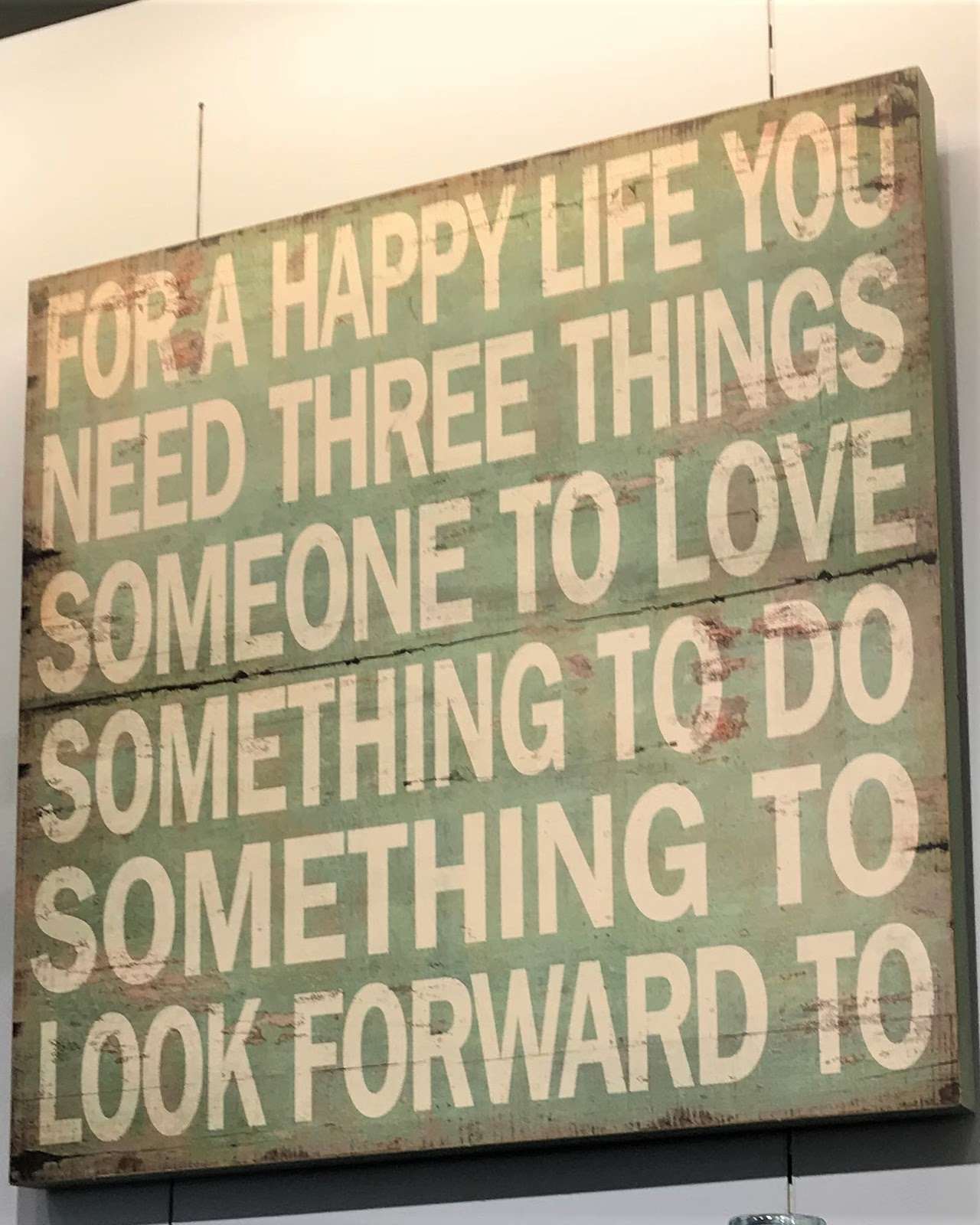
     Surprisingly, I found some pretty good quotes and life lessons scattered among the various displays of goods and wares.


     Which one is your favorite saying?


     Normally mine would be along the lines of "something to look forward to."


     But these days I'm more relaxed, content to let the time go by, and I'm more inclined toward the "sand in your toes" or "enjoy the ride" philosophy.


     Soon enough we'll be back out in the world, seeing old friends, meeting new people, engaging in our regular activities and embarking on new adventures.


     But for now, let's just relax and enjoy the day . . .


     And not lose our perspective or self-confidence.


          But don't rely on me. The gift shops say it better.